How to Use AI to Write Press Releases in 2026
The practical guide to using AI writing tools to produce professional press releases faster — so your news reaches the right journalists in the right format
This article contains affiliate links. If you purchase through these links, we may earn a commission at no extra cost to you. This does not affect our assessment — we only recommend tools we genuinely believe deliver value.
How to use AI to write press releases is one of the most practically valuable applications of AI writing tools for small businesses, startups, and professional services firms that want to generate media coverage without the cost of a PR agency. Press releases follow a strict structural format that journalists expect — deviate from it and your release goes unread. Get it right and a single press release can generate coverage in multiple outlets, creating backlinks, brand awareness, and credibility that paid advertising cannot replicate at the same cost. AI writing tools produce correctly structured, professionally worded press releases in minutes, making media outreach accessible for businesses of every size.
The honest context is that AI writing tools handle the structure and language of press releases extremely well — because press releases are one of the most format-driven pieces of business writing that exists. The newsworthiness of your announcement, the quality of your media list, and the follow-up that converts a press release into actual coverage all require human judgment. What AI tools eliminate is the blank page problem and the formatting uncertainty that prevents most small business owners from ever writing a press release at all. See our guide on how to save time using AI writing tools for the broader picture of where AI delivers the most value in business writing.
When to Write a Press Release
Not every business development warrants a press release — and understanding what is genuinely newsworthy is as important as knowing how to write the release itself. Events that typically justify a press release include: a significant new client win or partnership, a product or service launch, a major award or industry recognition, a senior hire or leadership change, research or data that reveals something interesting about your market, a business milestone such as a significant anniversary or revenue target, and community or charitable initiatives with local interest.
Events that do not warrant a press release include minor updates, routine business activities, and announcements that only matter to existing customers rather than to a broader audience. The test is simple: would a journalist reading the headline think ‘that is interesting and relevant to my readers’ or ‘why is this company emailing me about this’? If it is the latter, the announcement is better served by a direct client communication than a press release. For more on business communications that convert, see our guide on how to use AI to write case studies for a complementary approach to building credibility through documented results.
The Best AI Tool for Writing Press Releases
Rytr is the strongest AI writing tool for press release production. The dedicated press release template produces correctly structured releases from a brief description of your announcement — covering the headline, the lead paragraph, the supporting body paragraphs, the boilerplate, and the contact details in the format that journalists and editors expect. The output is professional, follows AP style conventions, and requires only factual personalisation rather than structural rewriting before use. At six pounds per month for the Saver plan — with a free plan offering ten thousand characters per month — Rytr is accessible to any business that wants to write a press release without the cost of a PR agency or copywriter. See our full Rytr review for the complete breakdown of Rytr’s templates beyond press releases.
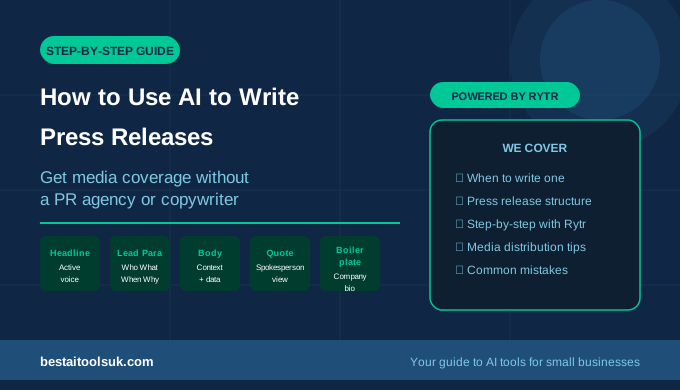
Press Release Structure: What AI Tools Need to Know
Before prompting any AI tool to write a press release, understanding the required structure ensures the output meets journalistic expectations. Every press release follows the same format, and AI tools produce significantly better output when given inputs organised around this structure.
The Headline
The headline is the single most important element of any press release — it determines whether a journalist reads further or deletes the email. A strong press release headline is specific, factual, and written in the active voice. It communicates the news in under fifteen words without marketing language or superlatives. ‘Manchester Tech Firm Secures £2.5 Million Series A to Expand AI Platform’ is a strong headline. ‘Exciting New Investment Announcement from Leading Technology Innovators’ is not.
The Lead Paragraph
The lead paragraph answers the five Ws — Who, What, When, Where, and Why — in two to three sentences. A journalist who reads only the headline and lead paragraph should understand the complete story. This is the most important paragraph in the release and the one where AI tools require the most specific input to produce strong output. The more concrete detail you provide about the announcement, the better the lead paragraph the AI produces.
The Body Paragraphs
The body of a press release typically contains two to three paragraphs that expand on the lead — providing context, quotes from relevant spokespeople, supporting data, and additional detail that helps a journalist understand the significance of the announcement. The inverted pyramid structure applies throughout: most important information first, supporting detail second, background last.
The Quote
Every press release should include at least one direct quote from a relevant spokesperson — the CEO, the founder, a senior partner, or a relevant expert. The quote should add something that the body paragraphs do not — a perspective, a vision statement, or an expression of significance that goes beyond the factual announcement. AI tools can generate placeholder quote language but the quote should be reviewed and approved by the person it is attributed to before submission. See our guide on how to write a business proposal for the professional writing principles that apply equally to press release quotes.
The Boilerplate
The boilerplate is a standard paragraph at the end of every press release that describes your company — what you do, when you were founded, how many clients you serve, and any relevant credentials or recognition. Once written, the same boilerplate is used in every press release you issue, requiring only minor updates as your business grows. AI tools produce strong boilerplate copy from a brief description of your business.
Contact Details
Every press release ends with the contact details of the person handling press enquiries — name, email address, and phone number. Journalists who want to follow up need to be able to reach a real person quickly. Always include direct contact details rather than a general enquiries email.
How to Use Rytr to Write a Press Release Step by Step
Step 1 — Prepare Your Announcement Details
Before opening Rytr, write down the key facts of your announcement: what happened, when it happened, who is involved, what the significance is, and one quote from a relevant spokesperson. The more specific and concrete this information, the better the AI output. A prompt that says ‘we won a new client’ produces a generic release. A prompt that says ‘we have been appointed by a FTSE 250 manufacturing company to deliver AI-powered quality control systems across their three UK sites, representing a contract worth £480,000’ produces a specific, newsworthy release.
Step 2 — Use Rytr’s Press Release Template
In Rytr, select the press release use case and enter your announcement details from Step 1 as specifically as possible. Enter a suggested headline, your key facts, and your spokesperson quote. Generate at least three variations and compare the headlines and lead paragraphs across all three — select the headline that is most specific and the lead paragraph that most clearly communicates the news. See our guide on how to use Rytr to write emails faster for the approach to Rytr prompting that transfers directly to press release production.
Step 3 — Review and Fact-Check Every Detail
AI tools occasionally introduce inaccuracies when generating content from brief inputs — particularly around numbers, dates, and specific claims. Review every factual statement in the AI-generated release against your actual announcement details before submission. A press release with a factual error that a journalist discovers will damage your credibility more than no press release at all.
Step 4 — Add the Quote and Boilerplate
Add the approved spokesperson quote and your company boilerplate to the AI-generated body of the release. These elements complete the standard press release format. If you do not yet have a boilerplate, use Rytr to generate one from a brief description of your company — it takes two minutes and is reusable for every future press release.
Step 5 — Distribute to a Targeted Media List
The quality of your media list determines whether your press release generates coverage. A targeted list of twenty relevant journalists — reporters who cover your industry, local business editors, and trade publication writers who reach your target audience — will generate more coverage than a mass distribution to five hundred general contacts. Research the journalists who cover your sector, personalise the email subject line for each, and include the press release in the body of the email rather than as an attachment. For the email approach that gets journalists to open and read, see our guide on how to write cold emails that get replies using AI for the principles that transfer directly to journalist outreach.
Common Mistakes in AI-Generated Press Releases
The most common mistake is using marketing language in a press release. Words like ‘revolutionary’, ‘world-class’, ‘cutting-edge’, and ‘game-changing’ immediately signal to journalists that the release is promotional rather than newsworthy. AI tools sometimes include this language in their output — always remove it and replace it with specific, factual claims.
The second most common mistake is burying the news. AI tools occasionally produce releases that spend the first paragraph on company background before getting to the announcement. The news should be in the headline and the first sentence — everything else is supporting context. For the broader approach to business writing that converts, see our guide to the best AI writing tools for small businesses.
The Honest Verdict
AI writing tools — specifically Rytr — genuinely solve the press release production problem for small businesses that have newsworthy announcements but lack the PR budget or copywriting skills to communicate them effectively. The structured output follows the format that journalists expect, the language is professional without being promotional, and the production time drops from two hours to fifteen minutes.
The businesses that get the most value from AI press releases are those who invest the time in Step 1 — preparing specific, factual announcement details — and who follow up their distribution with a brief, personalised email to the most relevant journalists. That combination consistently produces coverage at a fraction of the cost of a PR agency. Try Rytr free here and write your first AI-assisted press release today.
⭐ Try Rytr free — write a professional press release in minutes: Try Rytr free here
Published on bestaitoolsuk.com — Your trusted guide to AI tools for small businesses