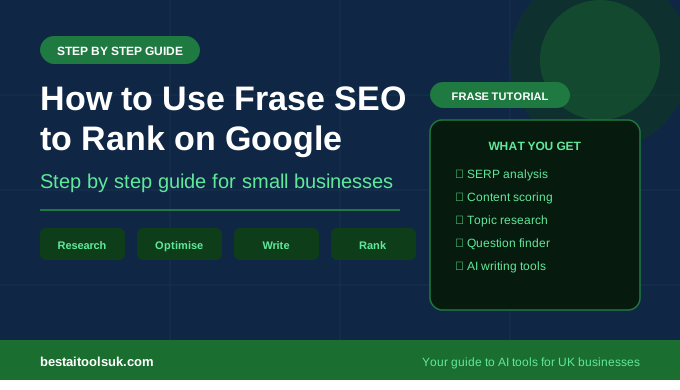
How to Use Frase to Rank on Google: A Step by Step Guide for Small Businesses
The practical guide to using Frase SEO content tools to get your small business website ranking on Google in 2026
This article contains affiliate links. If you purchase through these links, we may earn a commission at no extra cost to you.
Frase SEO is one of the most powerful tools available for small businesses that want to rank on Google without hiring an expensive SEO agency. At $12.66 per month it gives you access to the same kind of SERP analysis and content intelligence that professional SEO consultants use — but in a format that any small business owner can pick up and use immediately.
The problem most small businesses face with SEO is not a lack of effort. It is a lack of the right information. They publish blog posts without knowing what keywords to target, how long the content needs to be, what topics to cover, or how their content compares to what is already ranking. Frase solves all of these problems in one place.
This step by step guide shows you exactly how to use Frase for SEO that ranks on Google — from finding the right keywords to writing the article to optimising it before you publish. If you have not tried Frase yet, see our full Frase review for a complete breakdown of the platform and its pricing.
Why Most Small Business Content Does Not Rank on Google
Before diving into how Frase works, it helps to understand why most small business blog content fails to rank. The answer is almost always the same: the content was written without understanding what Google and its users actually want for that specific keyword.
Google ranks content based on how comprehensively and accurately it answers the search intent behind a keyword. If the top ranking articles on a topic cover ten specific subtopics and answer fifteen common questions, an article that covers three subtopics and answers two questions is very unlikely to outrank them — regardless of how well it is written.
Most small business owners write content based on what they think is useful rather than what the data shows is needed. Frase bridges this gap by showing you exactly what the top ranking content covers so you can create something that meets or exceeds the same standard. This data-driven approach is what separates content that ranks from content that disappears.
Getting Started With Frase
Step 1 — Create Your Frase Account
Go to frase.io and sign up for an account. Frase starts from $12.66 per month on annual billing, approximately £10 per month for UK users. There is no permanent free plan but the paid plan is accessible enough for any small business with a content marketing strategy.
Once logged in you will see the Frase dashboard. The main tools you will use are the Research tab for SERP analysis and the Document Editor for writing and optimising your content. Both are straightforward to navigate and you will be comfortable using them within your first session.
Step 2 — Create a New Document and Enter Your Keyword
Click New Document in your Frase dashboard. You will be prompted to enter your target keyword — this is the search term you want your article to rank for. Enter it and click Create Document.
Frase will immediately analyse the top ranking pages on Google for your keyword and populate your Research panel with the data. This typically takes 20 to 30 seconds. What you see next is the most valuable information available for writing content that ranks.
Good keyword examples for a small business blog:
- best AI writing tools for small businesses
- how to write a business proposal
- social media tips for small businesses
- how to get more customers for my small business
- best free tools for small business owners
Step 3 — Analyse the SERP Research Panel
The Research panel is where Frase earns its price. It shows you the top 20 results for your keyword broken down into useful data. Here is what to look at and what it means:
Average word count — Frase shows you the average word count of the top ranking articles. If the average is 1,800 words and your planned article is 600 words you are very unlikely to rank. Aim to match or slightly exceed the average.
Topic coverage — Frase identifies the key topics and subtopics covered across the top ranking pages. These are displayed as a list of terms with scores showing how frequently they appear in top ranking content. Topics with high scores are essential to include in your article.
Questions — Frase extracts the questions that appear across top ranking content and in People Also Ask boxes. These are the questions your article should answer. Incorporating them into your subheadings or dedicated FAQ sections significantly improves your chances of ranking.
Content score — Frase gives each top ranking article a content score based on how comprehensively it covers the key topics. Your target is to write content that achieves a score equal to or higher than the top three results.
Step 4 — Create Your Content Brief
Before writing, use the research data to create a content brief — essentially an outline of what your article needs to cover. A good brief includes:
- Target keyword and secondary keywords to incorporate naturally
- Target word count based on the average of top results
- H2 and H3 subheadings covering the main topics identified by Frase
- Questions to answer drawn from the Frase questions panel
- Key topics to cover drawn from the Frase topic panel
This brief takes about ten minutes to create with Frase and eliminates the most common reasons content fails to rank. It also makes the writing process significantly faster because you have a clear structure before you start.
Step 5 — Write Your Content in the Frase Editor
The Frase Document Editor is where you write your article. As you write, the content score in the right panel updates in real time showing how comprehensively you are covering the required topics. This live feedback loop is one of Frase’s most practical features — you can see exactly which topics you still need to cover without having to check your brief manually.
You can write directly in the Frase editor or paste content from another tool. Many small business owners use a combination — drafting quickly in an AI writing tool like Rytr or Koala AI and then pasting into Frase to optimise. See our Rytr review for the best budget option for this workflow.
The AI writing features built into Frase can also help you expand sections, generate introductions, or fill in gaps identified by the content score. These are useful for speeding up the writing process without leaving the platform.
Step 6 — Optimise Your Content Score
As you write, aim to reach a content score that matches or exceeds the average of the top three ranking articles for your keyword. Frase shows you this benchmark clearly so you always know your target.
The most efficient way to improve your score is to work through the topics panel systematically. Click on any topic with a low score and Frase highlights where it appears in the top ranking content, giving you context for how to incorporate it naturally into your own article.
Do not force topics in artificially — Google’s algorithms are sophisticated enough to identify content that includes terms without genuinely addressing them. The goal is comprehensive coverage of the topic, not keyword stuffing. If a topic from Frase’s list is not relevant to your specific angle on the subject, it is acceptable to leave it out.
Step 7 — Review and Publish
Before publishing, run through this final checklist:
- Content score matches or exceeds the average of the top three results
- Word count is at or above the average of top ranking articles
- All high-priority topics from the Frase panel are covered naturally
- Key questions are answered either in the body text or a dedicated FAQ section
- The article has a clear structure with descriptive H2 and H3 subheadings
- Your target keyword appears in the title, first paragraph, at least one H2, and the meta description
Once these boxes are ticked you have created content that is genuinely competitive with what is currently ranking. It will not rank overnight — Google typically takes several weeks to months to rank new content — but the foundation is right and the chances of ranking are significantly higher than content created without this process.
The Frase Workflow in Practice
How Long Does This Process Take?
Once you are comfortable with the platform, the full Frase workflow from keyword entry to publication-ready content takes between 60 and 90 minutes for a standard 1,500 word article. This breaks down roughly as follows:
- SERP research and analysis — 10 minutes
- Content brief creation — 10 minutes
- First draft writing — 30 to 40 minutes
- Optimisation against Frase content score — 15 to 20 minutes
- Final review and formatting — 10 minutes
Compare this to the alternative — writing without any SEO guidance, publishing, and hoping for rankings — and the time investment is entirely justified. An hour of structured Frase-guided writing produces content that is far more likely to rank than two hours of unguided writing.
Combining Frase With Other AI Writing Tools
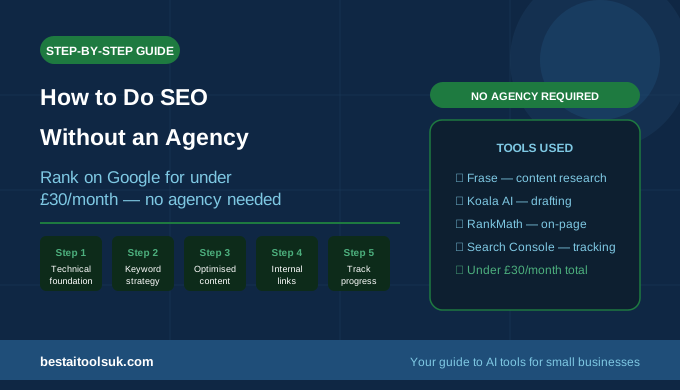
Many small business owners get the best results by combining Frase with a faster AI writing tool for the drafting phase. The recommended workflow is to use Frase for research and optimisation — which it does exceptionally well — and use a tool like Rytr or Koala AI to generate a fast first draft based on your Frase content brief.
This combined approach gives you the speed advantages of AI writing with the SEO intelligence of Frase. The draft gets you to a starting point quickly and Frase ensures the final output is optimised to rank. For high volume content production this workflow is significantly more efficient than using either tool alone.
Common Frase Mistakes to Avoid
Targeting Keywords That Are Too Competitive
Frase gives you excellent data on what it takes to rank for any keyword, but it cannot change the competitive landscape. A brand new website trying to rank for a keyword dominated by established authority sites with thousands of backlinks will struggle regardless of content quality. Use Frase alongside a keyword difficulty tool to prioritise keywords where new content has a realistic chance of ranking. Lower competition keywords with clear search intent are almost always the better starting point for small businesses.
Chasing Content Score at the Expense of Quality
Frase’s content score is a useful guide but not an absolute target. Some small business owners become so focused on maximising their score that they force in topics awkwardly or pad content unnecessarily. Google evaluates content quality holistically — a 1,400 word article that is genuinely useful and well-structured will often outperform a 2,000 word article bloated with forced keywords. Use the content score as a guide, not a target to hit at any cost.
Not Updating Old Content
One of the most underused features in Frase is the ability to analyse and re-optimise existing content. If you have blog posts that are ranking on page two or three of Google, running them through Frase often reveals topic gaps that, once filled, are enough to push them onto page one. Existing content that is already indexed and has some authority is often easier to rank than brand new content — do not neglect it.
How Much Traffic Can Frase Help You Generate?
The honest answer is that Frase does not guarantee rankings or traffic — no tool can. What it does is significantly increase the probability that your content ranks by ensuring it meets the standards Google uses to evaluate content quality and comprehensiveness.
Small businesses using Frase consistently report that their content reaches the first page of Google significantly more often than content produced without SEO guidance. For a small business where organic search traffic is a primary growth channel, even moving from page two to page one for a handful of relevant keywords can represent a meaningful increase in website visitors, enquiries, and sales.
The compounding effect is also significant. Every piece of Frase-optimised content you publish is another potential source of ongoing organic traffic. Unlike paid advertising which stops the moment you stop paying, well-optimised blog content can drive traffic for months or years. At $12.66 per month, Frase is one of the highest return investments available for a small business serious about growing through organic search.
⭐ Ready to start ranking on Google? Frase gives you everything you need to create content that competes in search results. Try Frase here → frase.io