How to Do SEO Without an Agency in 2026: The Small Business Guide
A practical, step-by-step guide to ranking on Google yourself — using AI tools that cost less per month than an hour of agency time
This article contains affiliate links. If you purchase through these links, we may earn a commission at no extra cost to you. This does not affect our assessment — we only recommend tools we genuinely believe deliver value.
How to do SEO without an agency is the question that most small business owners are asking in 2026 — and the honest answer is that it has never been more achievable than it is right now. SEO agencies charge between £500 and £3,000 per month for services that, in many cases, involve producing optimised content and building the technical foundation that AI tools now make accessible to any business owner willing to invest consistent effort. This guide shows you exactly how to do the most important parts of SEO yourself, using affordable AI tools that cost under £30 per month combined, without a technical background or a marketing qualification.
The honest caveat is that doing SEO without an agency requires consistency and patience — the results take three to six months to materialise, and the work needs to be done every week rather than in occasional bursts. What AI tools provide is the efficiency that makes this consistency achievable alongside running a business — reducing the time required per piece of content from two hours to twenty minutes, and removing the guesswork from what that content needs to cover. For the broader context of AI tools available for this task, see our guide to the best AI SEO tools for small businesses.
What SEO Actually Involves — and What You Can Do Yourself
SEO has three main components. Technical SEO covers the structural and code-level factors that determine whether Google can crawl and understand your website. On-page SEO covers the content and optimisation of individual pages — the keywords, headings, content depth, and metadata that signal relevance to search engines. Off-page SEO covers the links from other websites pointing to yours, which signal authority and trustworthiness to Google.
The good news for small businesses doing SEO without an agency is that technical SEO for most small business websites is straightforward to get right once and then maintain. On-page SEO — the part that involves producing optimised content — is where most of the ongoing work happens and where AI tools deliver the most significant time savings. Off-page SEO is the most complex and the part where agencies typically add the most value — but for most small businesses, producing consistent high-quality content is the more important priority than link building in the early stages. For a full breakdown of the tools that support each component, see our best AI SEO tools for small businesses guide.
Step 1 — Get the Technical Foundation Right
Install RankMath or Yoast SEO
If your website runs on WordPress — which covers the majority of small business websites — install RankMath or Yoast SEO as your SEO plugin immediately if you have not already done so. Both are free and handle the most important technical SEO requirements automatically: XML sitemap generation, meta tag management, structured data markup, and on-page optimisation guidance. RankMath is the stronger option in 2026 — the free version covers more features than Yoast’s free version and the interface is more intuitive for non-specialists.
Submit Your Sitemap to Google Search Console
Google Search Console is a free tool from Google that allows you to see how Google views your website — which pages are indexed, which search terms your pages appear for, and whether Google has encountered any technical issues. Set it up by going to search.google.com/search-console, verifying ownership of your website, and submitting your sitemap URL. RankMath generates your sitemap automatically — it is typically at yourwebsite.com/sitemap_index.xml. Once submitted, Google will use the sitemap to discover and index your pages more efficiently. See our guide on how to use Frase for SEO for how Search Console data can inform your content strategy.
Ensure Your Website Loads Fast
Page speed is a direct ranking factor in Google’s algorithm. A website that loads in under three seconds consistently ranks better than one that takes five or more seconds, all other things being equal. Use Google’s free PageSpeed Insights tool to assess your current loading speed and identify the most impactful improvements. For WordPress users, installing a caching plugin — LiteSpeed Cache if your hosting supports it, otherwise WP Rocket — typically produces the most significant speed improvements with minimal technical complexity.
Make Sure Your Website Works on Mobile
Google uses mobile-first indexing — meaning it primarily uses the mobile version of your website for ranking and indexing decisions. If your website does not display correctly on a smartphone, your rankings will suffer regardless of how good your content is. Most modern WordPress themes are mobile-responsive by default — check your site on a smartphone browser and fix any display issues before investing significant time in content.
Step 2 — Build Your Keyword Strategy
Identify What Your Customers Are Searching For
Keyword research is the process of identifying the specific search terms your prospective customers use when looking for what you offer. The goal is to find keywords that have sufficient search volume to generate meaningful traffic and are achievable for a website of your authority to rank for. Use Frase’s keyword research capability or the free version of Google Keyword Planner to identify the search terms most relevant to your business. For each keyword, assess whether the search intent matches what your page offers — a keyword with high search volume is useless if the people searching it are not looking for what you sell. See our Frase vs Semrush comparison for a breakdown of keyword research tools at different price points.
Prioritise Long-Tail Keywords
Long-tail keywords — more specific, longer search phrases — are the most achievable starting point for small businesses doing SEO without an agency. Rather than targeting ‘accountant’, target ‘small business accountant Manchester’ or ‘accountant for freelancers’. Rather than targeting ‘personal trainer’, target ‘personal trainer for beginners London’ or ‘online personal trainer weight loss’. Long-tail keywords have lower search volumes but attract more qualified prospects, are significantly easier to rank for with a newer or smaller website, and often convert at higher rates because the searcher’s intent is more specific.
Step 3 — Produce Optimised Content Consistently
Use Frase to Research and Brief Every Piece of Content
Frase is the most important tool in the DIY SEO toolkit. For every piece of content you plan to produce, enter the target keyword into Frase before writing a single word. Frase analyses the top twenty Google results for that keyword and produces a content brief showing exactly what your page needs to cover — the headings the competing pages use, the questions they answer, the topics they include, and the word count they reach. This research removes the guesswork from content creation and ensures every piece you publish is structured in the way Google is already rewarding for that search term. Try Frase here with the five-day free trial to see the content brief workflow in action on your first target keyword.
Use Koala AI or Frase to Produce the Content
Once you have a content brief from Frase, you can either write the content yourself using the brief as a framework, or use Frase’s built-in AI writing tools or Koala AI to produce a first draft. Koala AI’s five-minute article generation — informed by real-time SERP analysis — produces well-structured first drafts that cover the key topics from your brief and require editing and personalisation rather than complete rewriting. For small businesses that need to produce content at volume to build search visibility, this combination of Frase for research and Koala AI for drafting dramatically reduces the time per piece of content without sacrificing quality. See our full Koala AI review for the complete assessment of output quality.
Optimise Every Page With RankMath Before Publishing
Before publishing any piece of content, check the RankMath score in the WordPress editor. RankMath analyses your page for the target keyword and produces a score out of one hundred — aim for eighty or above on every piece you publish. The most common fixes are ensuring the keyword appears in the title, the first paragraph, at least one H2 heading, the meta description, and the image alt text. RankMath guides you through each of these requirements with a clear checklist. Once you are consistently hitting eighty or above, your on-page technical optimisation is strong. For the broader content production workflow, see our guide on how to use AI to write blog posts in half the time.
Publish Consistently — Frequency Matters
The businesses that build the fastest search visibility are those that publish consistently — one to four pieces of optimised content per week — rather than sporadically. Google rewards websites that produce regular, quality content because it signals that the site is active and authoritative. AI tools make this publishing frequency achievable alongside running a business by reducing the time per piece from two hours to twenty minutes. Consistency over twelve months compounds into search visibility that is genuinely difficult for competitors to replicate quickly.
Step 4 — Build Internal Links Between Your Pages
Internal linking — linking from one page on your website to another — is one of the most underutilised SEO tactics available to small businesses. Every time you publish a new page, go back to your three or four most relevant existing pages and add a link to the new content. Every new page you publish should also link out to your three or four most relevant existing pages. This builds a web of connections that helps Google understand the structure and depth of your content, and passes authority between pages in ways that improve rankings across your entire site. It takes five minutes per piece of content and produces a compounding benefit over time. For the strategy behind effective internal linking, see our guide to the best AI writing tools for small businesses.
Step 5 — Track Your Progress in Google Search Console
Once you have been publishing consistently for six to eight weeks, your Google Search Console data will start to show meaningful patterns — which keywords your pages are appearing for, how many clicks they are generating, and which pages are gaining search visibility fastest. Use this data to identify which content topics are resonating with Google’s algorithm and produce more content in those areas. Track your average position for target keywords over time — consistent improvement from position forty to position twenty to position ten is the signal that your DIY SEO strategy is working.
What DIY SEO Cannot Replace
There are two areas where an SEO agency consistently adds value that is difficult to replicate without significant expertise and time investment. The first is link building — the process of acquiring links from other websites to yours, which builds domain authority and is one of the most significant ranking factors for competitive keywords. Building links requires outreach, relationship building, and content creation specifically designed to attract links — it is time-consuming and benefits significantly from professional expertise. The second is competitive intelligence — understanding the full competitive landscape of your niche and identifying opportunities and threats in ways that require comprehensive data analysis. For both of these, see our Frase vs Ahrefs comparison for the tools that support these more advanced SEO activities.
The Honest Verdict
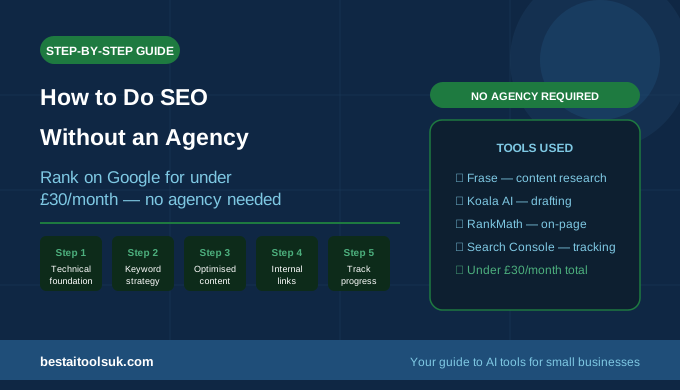
Doing SEO without an agency is achievable for most small businesses in 2026 — and the combination of Frase for content research, Koala AI for content production, RankMath for on-page optimisation, and Google Search Console for performance tracking covers the most important elements of an effective SEO strategy at a combined cost of under £30 per month. The missing element is link building and advanced competitive intelligence — which is where agencies earn their fee for businesses competing in genuinely competitive national markets.
For most local and niche small businesses, however, consistent production of well-optimised content using the tools above will generate meaningful search visibility within three to six months without agency involvement. The businesses that struggle with DIY SEO are those that produce content inconsistently, do not research their keywords before writing, or expect results in the first four to eight weeks before Google has had time to discover and index their new content. Start with Frase here and build your first content brief today — the five-day trial is enough to see exactly what a structured, research-led approach to content produces.
⭐ Try Frase free for 5 days — start ranking without an agency: Try Frase here⭐ Try Koala AI — produce SEO content in minutes: Try Koala AI here
Published on bestaitoolsuk.com — Your trusted guide to AI tools for small businesses