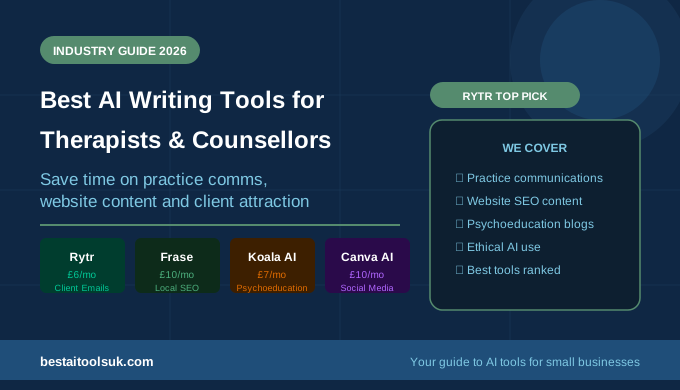
Best AI Writing Tools for Therapists and Counsellors in 2026
The practical guide to AI writing tools that help therapists and counsellors save time on client communications, website content and practice marketing
This article contains affiliate links. If you purchase through these links, we may earn a commission at no extra cost to you. This does not affect our assessment — we only recommend tools we genuinely believe deliver value.
Best AI writing tools for therapists and counsellors are helping private practitioners and therapy practices manage the written communications and marketing content that surround their clinical work — without compromising the professional standards and ethical boundaries that the therapeutic relationship requires. Running a therapy practice involves a significant volume of written content beyond the clinical work itself: enquiry response emails, website service pages, blog articles explaining therapeutic approaches, social media posts to build awareness, newsletter content for existing and past clients, and psychoeducation resources that clients can use between sessions. AI writing tools handle all of this non-clinical written content efficiently and professionally.
The honest context is that AI writing tools must be used with particular care in therapeutic contexts. No AI tool should be used to produce clinical formulations, session notes, therapeutic interventions, or any content that constitutes clinical advice or guidance specific to an individual client. What AI tools do well is handle the non-clinical written communications that surround therapy — the practice marketing, the website content, the educational articles, and the professional communications that help therapists build and sustain a full private practice. See our guide to the best AI tools for small business marketing for the broader context of how these tools fit into a private practice marketing strategy.
Best AI Writing Tools for Therapists and Counsellors: Quick Comparison
| Tool | Best For | Starting Price | Free Plan |
| Rytr | Client emails, website copy, social posts | £6/month | Yes — 10,000 chars/month |
| Frase | Mental health blog content, SEO articles | £10/month | No — 5-day trial |
| Koala AI | Therapeutic guides, high-volume content | £7/month | Trial credits |
| Canva AI | Social media graphics, client materials | Free / £10/month | Yes |
| ChatGPT | Resource guides, psychoeducation content | Free / £16/month | Yes |
Why Therapists Are Using AI Writing Tools in 2026
Private practice therapists face a specific challenge that most other small business owners do not: the work itself is deeply relational and emotionally demanding, which means the administrative and marketing tasks that surround the clinical work often get neglected during and after a full day of sessions. Writing a blog post, updating website service pages, or maintaining a social media presence requires a different kind of mental energy than clinical work — and AI tools provide a way to produce that content without the cognitive drain of writing from scratch after an emotionally intensive working day.
The therapists and counsellors who are building the most sustainable private practices in 2026 are increasingly those who have systematised their non-clinical written communications — using AI tools to produce professional content consistently without it consuming significant time or mental energy. For the most cost-effective approach to building this capability, see our guide to the best free AI tools for small businesses.
The Best AI Writing Tools for Therapists and Counsellors
1. Rytr — Best for Practice Communications and Social Media
Rytr is the strongest all-round AI writing tool for therapists who need to produce a variety of practice communications and marketing content quickly and affordably. The email templates handle enquiry responses, intake information messages, and practice newsletter content professionally — with a warm, accessible tone that matches the register most therapy practices want to project. The social media templates produce Instagram and Facebook posts that build awareness of the practice and the therapist’s approach without crossing into promotional language that can feel incongruent with a therapeutic brand.
At six pounds per month for the Saver plan — with a free plan offering ten thousand characters per month — Rytr is the most accessible entry point for private practitioners managing tight practice budgets. For solo practitioners who see clients five days per week and have limited administrative time, the time saving on routine written communications is significant. See our full Rytr review for the complete breakdown of templates and use cases.
Best for: Enquiry response emails, practice newsletter content, social media posts, website about page copy, psychoeducation resource descriptions.
Starting price: Free plan available — Saver plan from £6/month. Try Rytr free here.
2. Frase — Best for Therapy Website Content and SEO
Frase is the strongest AI tool for therapists who want to attract new clients through Google search rather than relying entirely on directory listings or word-of-mouth referrals. Prospective clients searching for a therapist in their area, or for information about specific therapeutic approaches, are high-intent prospects who are actively looking for support. Therapists with well-optimised website content — service pages, approach explanations, and regularly published blog articles — consistently appear in these searches and attract more enquiries than those without.
For a therapist investing in their website, Frase makes the difference between a website that generates consistent new enquiries and one that is invisible to anyone who does not already know to search for that specific therapist. A well-ranked article explaining cognitive behavioural therapy in accessible language, or a local ‘therapist in [city]’ service page, can generate regular enquiries for months after publication. The Solo plan at ten pounds per month is affordable for most private practitioners. See our full Frase review and our guide on how to use Frase for SEO for the workflow.
Best for: Therapy approach explanations, local SEO service pages, mental health blog articles, new client attraction through Google search.
Starting price: 5-day free trial — Solo plan from £10/month. Try Frase here.
3. Koala AI — Best for Psychoeducation and Blog Content
Koala AI is the strongest tool for therapists who want to maintain a regular blog of psychoeducation articles — content that explains mental health topics, coping strategies, and therapeutic concepts in accessible language that is valuable to both existing clients and prospective clients searching online. The five-minute full article generation, with real-time web browsing for current research and clinical guidance, produces content that is more accurate and more current than tools relying solely on training data.
For therapists who want to use content marketing as a primary client attraction strategy — publishing regular articles about anxiety, depression, relationship issues, or specific therapeutic modalities — Koala AI dramatically reduces the production time without sacrificing the quality that builds credibility with a discerning audience. All clinical content must be reviewed by the therapist before publication to ensure accuracy and alignment with current evidence-based practice. See our full Koala AI review for the complete assessment.
Best for: Psychoeducation articles, mental health blog content, coping strategy guides, therapeutic approach explainers, client resource content.
Starting price: Trial credits available — plans from £7/month. Try Koala AI here
4. Canva AI — Best for Social Media and Client Materials
Canva AI is the strongest tool for therapists who want to maintain a professional visual presence on social media without design skills or a marketing budget. Awareness posts for mental health awareness days, quotes from therapeutic literature shared as graphics, and practice information posts all benefit from professional design — which Canva AI makes achievable in minutes. The Brand Kit feature ensures consistent visual identity across all practice materials, and Magic Write generates accessible captions directly within the design editor.
For therapists who post regularly on Instagram or Facebook — which is increasingly important for reaching younger adult client populations — Canva AI reduces the time required to produce professional-looking content significantly. The free plan covers most basic needs. See our Canva AI review for the full breakdown.
Best for: Mental health awareness social media content, therapy quote graphics, practice information posts, client resource infographics.
Starting price: Free plan available — Pro from £10/month.
5. ChatGPT — Best for Psychoeducation Research and Resource Drafts
ChatGPT is the most flexible tool for therapists who need support producing psychoeducation resource drafts and research summaries. Asking ChatGPT to produce an accessible explanation of a therapeutic concept, to summarise the evidence base for a specific intervention in plain language, or to draft a client information leaflet about anxiety management techniques — these are tasks where ChatGPT’s flexibility makes it useful as a starting point for the therapist’s own content development.
All clinical content produced with ChatGPT assistance must be reviewed and verified by the therapist for accuracy and alignment with current evidence-based practice before use with clients or in public-facing materials. The free plan is sufficient for most use cases. See our comparison of ChatGPT vs Rytr for a direct breakdown of which tool suits which therapy practice writing task.
Best for: Psychoeducation resource drafts, evidence base summaries in plain language, client information leaflet frameworks, flexible ad hoc writing support.
Starting price: Free plan available — ChatGPT Plus from £16/month.
How Therapists Are Using AI Writing Tools in Practice
Enquiry Response Communications
The enquiry response email is often the first written communication a prospective client receives from a therapist — and it sets the tone for the therapeutic relationship before the first session. AI tools produce warm, professional enquiry response templates that therapists can personalise with specific details, saving the time of drafting from scratch while maintaining the human touch that prospective clients need. See our guide on how to use Rytr to write emails faster for the email workflow that works best for professional services practices.
Website Content and Client Attraction
Therapists who invest in their website with clear, accessible explanations of their approach, their specialisms, and what clients can expect from therapy consistently attract more enquiries than those with sparse or generic websites. AI tools make producing and updating this content achievable alongside a full clinical caseload. Frase ensures the content ranks for the search terms prospective clients actually use when looking for therapeutic support. See our guide on how to use AI to write blog posts in half the time for the content production workflow that works best for therapists.
Newsletter and Community Building
Some therapists maintain a newsletter for past and current clients — sharing psychoeducation content, mental health resources, and practice updates that maintain a professional connection without constituting ongoing therapeutic contact. AI tools make producing this content consistently achievable, ensuring the newsletter goes out regularly rather than being deprioritised when clinical work is busy. See our guide on how to use AI for email marketing for the approach that works best for professional services newsletters.
Ethical Considerations for Therapists Using AI Writing Tools
Therapists using AI writing tools should ensure that no client-identifying information is included in prompts to any AI tool, as this would constitute a breach of client confidentiality. All content produced for client-facing use — whether for the practice website, social media, or client resources — should be reviewed and approved by the therapist before publication or distribution.
AI writing tools are most safely and ethically used for non-clinical practice communications — marketing content, website copy, educational articles, and professional correspondence — rather than for clinical documentation or client-specific communications. For the broader context of AI tools in professional services, see our guide to the best AI writing tools for financial advisers for how another regulated profession approaches AI tool use thoughtfully.
The Honest Verdict
The best AI writing tools for therapists and counsellors in 2026 are Rytr for practice communications and social media, Frase for website content and local SEO, and Koala AI for psychoeducation blog content. Together these tools cover the full range of non-clinical written content most private practitioners need to produce, at a combined cost of under twenty-five pounds per month.
The starting point for most therapists is Rytr — the free plan is risk-free and the email and social media templates deliver immediate time savings from the first use. For therapists who want to attract new clients through their website rather than relying entirely on directories, Frase at ten pounds per month is the most impactful addition. Try Rytr free here and see how much time it saves on your next batch of practice communications.
⭐ Try Rytr free — no credit card required: Try Rytr free here⭐ Try Frase — attract new clients through Google search: Try Frase here
Published on bestaitoolsuk.com — Your trusted guide to AI tools for small businesses