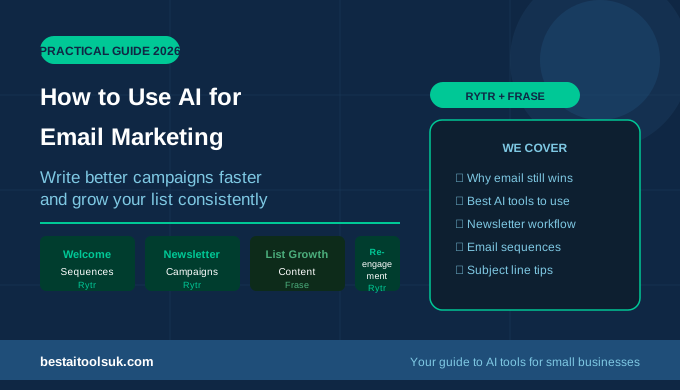
How to Use AI for Email Marketing in 2026: The Small Business Guide
The practical guide to using AI writing tools to produce better email campaigns faster — so your emails get opened, read and acted on
This article contains affiliate links. If you purchase through these links, we may earn a commission at no extra cost to you. This does not affect our assessment — we only recommend tools we genuinely believe deliver value.
How to use AI for email marketing is one of the most valuable applications of AI writing tools for small businesses in 2026. Email remains the highest-return marketing channel available — research consistently shows that email marketing generates significantly higher return on investment than social media, paid advertising, or content marketing for most small businesses. The challenge is not the channel but the execution: writing email campaigns consistently, maintaining an engaging tone that builds relationships with subscribers, and producing the volume of content that keeps an email list warm and responsive. AI writing tools address all three of these challenges directly.
The honest context is that AI writing tools are a production accelerator for email marketing rather than a replacement for strategy and genuine relationship building. The understanding of your audience, the value you provide to subscribers, and the authentic voice that makes people want to open your emails all require your knowledge and judgment. What AI tools eliminate is the production friction — the time spent drafting, redrafting, and second-guessing email copy that could be better spent on the strategy and relationship work that actually drives results. See our guide on how to use AI writing tools to grow your email list for the strategy that works alongside the production tools this guide covers.
Why Email Marketing Remains the Highest-Return Channel
Unlike social media, where your content reaches only a fraction of your followers due to algorithmic filtering, email lands directly in the inbox of every subscriber who has actively chosen to hear from you. Unlike paid advertising, there is no cost per send once you have built the list. And unlike SEO content, which takes months to generate traffic, email generates immediate responses from an audience that already knows and trusts your business.
The small businesses that generate the most consistent revenue from email marketing are those that send regularly — at least monthly, ideally fortnightly or weekly — with content that delivers genuine value to subscribers rather than purely promotional messages. AI writing tools make this publishing frequency achievable for business owners who previously found consistent email production too time-consuming to sustain. For the broader picture of how content drives business growth, see our guide to the best AI tools for small business marketing.
The Best AI Tools for Email Marketing
Rytr — Best for Email Copy Production
Rytr is the strongest AI writing tool for email marketing copy production. The email newsletter, marketing email, and follow-up email templates produce well-structured, engaging email copy from a brief description of the message you want to send. The output captures a professional but personal tone — the register that works best for small business email marketing — and generates multiple variations so you can choose the approach that best matches your voice and your subscriber relationship.
At six pounds per month for the Saver plan — with a free plan offering ten thousand characters per month — Rytr is the most accessible AI tool for small business email marketing. A business owner who sends one email per week can produce a month’s worth of email drafts in under an hour using Rytr’s email templates, compared to the four to six hours the same content would take to write manually. See our full Rytr review for the complete breakdown of Rytr’s email templates and how they compare to competing tools.
Frase — Best for List Growth Content
Frase is the strongest AI tool for producing the content that grows your email list in the first place. Blog posts, guides, and landing pages that rank on Google for topics your ideal subscribers search for are the most sustainable source of new email subscribers for most small businesses. Frase’s SERP analysis identifies exactly what that content needs to cover to rank, and its content editor ensures each piece is optimised before publication.
For small businesses that want to grow their email list through organic search rather than paid advertising, Frase is the most commercially valuable tool in the email marketing stack — not because it writes emails, but because it produces the content that brings new subscribers to your list consistently. See our full Frase review for the complete workflow and our guide on how to use Frase for SEO for the step-by-step process.
How to Use AI to Write Email Newsletters
Step 1 — Define Your Newsletter’s Core Value
Before writing any email with AI assistance, be clear about what your newsletter delivers to subscribers that they cannot easily get elsewhere. This value proposition — the reason someone stays subscribed rather than unsubscribing — should inform every email you produce. The best small business newsletters deliver one of three things consistently: curated information that saves the subscriber research time, practical advice they can apply immediately, or an inside perspective on your industry that they find genuinely interesting.
Step 2 — Plan the Email Before Opening Rytr
AI tools produce better email copy when given a clear brief rather than a vague prompt. Before opening Rytr, decide on three things: the single main message or value your email will deliver, the one action you want subscribers to take after reading, and any specific details — statistics, examples, or stories — that will make the email feel specific and genuine rather than generic. This planning takes five minutes and produces meaningfully better AI output.
Step 3 — Use Rytr’s Email Newsletter Template
In Rytr, select the email newsletter or marketing email use case and enter your planned content from Step 2. Be as specific as possible — the more concrete the input, the more engaging the output. Generate at least three variations and select the subject line and opening paragraph that best captures the value your email delivers. The subject line is the most important element of any email — it determines whether the email gets opened at all. See our guide on how to use Rytr to write emails faster for the detailed workflow that works best for newsletter production.
Step 4 — Add Personality and Specific Detail
AI-generated newsletter copy provides the structure and professional language — but the emails that generate the highest open rates and click-through rates are those that feel personal and specific. Add one personal observation, one specific example from your own experience, or one piece of genuinely useful information that makes the email feel like it came from a real person who knows their audience. This takes five minutes and is the most impactful edit you can make to any AI-generated email.
Step 5 — Write a Strong Subject Line
Rytr generates subject line options alongside the email body — always review all of them and test the strongest. Strong email subject lines are specific rather than generic, create curiosity or communicate clear value, and are under fifty characters so they display fully on mobile screens. The subject line determines your open rate — which determines everything else. Produce five to ten subject line variations using Rytr and choose the strongest, or A/B test two different options if your email platform supports it.
AI-Assisted Email Sequences for Small Businesses
Welcome Email Sequences
The welcome email sequence — the series of emails a new subscriber receives after joining your list — is the highest-read email content any business sends. New subscribers are at peak engagement immediately after joining, which makes the welcome sequence the most important place to invest in strong copy. Rytr can produce a complete three to five email welcome sequence from a brief description of your business and what subscribers can expect — covering the initial welcome, your core value proposition, your best existing content, and a first call to action. See our guide on how to write cold emails that get replies using AI for the email writing principles that apply equally to welcome sequences.
Promotional Email Sequences
Product launches, service promotions, and special offer campaigns all benefit from a sequenced email approach — building anticipation, delivering value, and closing with urgency rather than sending a single promotional email that most subscribers ignore. Rytr’s email templates handle each stage of a promotional sequence reliably, and the ability to produce the full sequence in under an hour means even small businesses can run sophisticated email campaigns without a dedicated marketing function.
Re-engagement Sequences
Every email list contains subscribers who have not opened an email in three to six months. A well-written re-engagement sequence — typically two to three emails that acknowledge the gap and offer renewed value — can recover a significant proportion of these inactive subscribers before they need to be removed from the list entirely. Rytr’s email templates produce effective re-engagement copy from a brief description of your business and the value you want to reconnect with the subscriber. For the strategy behind list management, see our guide on how to use AI writing tools to grow your email list.
Email Marketing Best Practices When Using AI
AI-generated email copy should always be reviewed and personalised before sending. The most important check is tone — AI tools sometimes produce copy that is too formal or too generic for the specific relationship you have with your subscribers. Read the AI draft aloud and edit any sentence that does not sound like something you would actually say.
Subject line testing is the highest-leverage optimisation available in email marketing. Most email platforms allow A/B testing of subject lines — always test at least two subject line options on larger sends, and use the results to inform future email writing. Over time, you will develop a clear picture of which subject line styles your specific audience responds to, which makes AI prompting for subject lines progressively more effective. For more on email marketing as part of a broader content strategy, see our guide to the best AI writing tools for small businesses.
The Honest Verdict
AI writing tools — specifically Rytr for email copy and Frase for list-building content — genuinely transform email marketing for small businesses that have struggled with consistent production. The time investment for a weekly email newsletter drops from ninety minutes to twenty minutes, which makes consistent email marketing achievable alongside a full working week rather than something that gets deprioritised when the business is busy.
The small businesses that get the best results from AI-assisted email marketing are those who invest in the brief before prompting — defining the value, the message, and the action clearly before opening the tool — and then add the personal specificity that makes the AI output feel genuine. That combination consistently produces emails that subscribers open, read, and act on. Try Rytr free here and produce your first AI-assisted email campaign today.
⭐ Try Rytr free — write better emails in minutes: Try Rytr free here⭐ Try Frase — produce content that grows your email list organically: Try Frase here
Published on bestaitoolsuk.com — Your trusted guide to AI tools for small businesses