How to Use AI to Write Website Copy in 2026: A Small Business Guide
A practical guide to using AI tools to write homepage copy, service pages, about pages and CTAs that convert visitors into customers — without hiring a copywriter
This article contains affiliate links. If you purchase through these links, we may earn a commission at no extra cost to you. This does not affect our assessment — we only recommend tools we genuinely believe deliver value.
How to use AI to write website copy is one of the most practically valuable questions a small business owner can ask in 2026. Your website is your most important sales tool — it works for you twenty-four hours a day, seven days a week, reaching prospective customers at the exact moment they are looking for what you offer. The quality of your website copy directly determines how many of those visitors contact you, buy from you, or move on to a competitor. And yet most small business websites have copy that was written in a rush when the site was first built, has not been updated since, and does not clearly communicate what makes the business worth choosing over its competitors.
AI tools have made professional-quality website copywriting accessible to any business owner willing to invest a few hours in the process. The combination of a clear understanding of your business, your customers, and your competitors — which only you can provide — with the drafting speed and structural knowledge of AI tools produces website copy that is significantly stronger than most small businesses currently have. This guide takes you through every major section of a small business website and shows you exactly how to use AI tools to write copy that converts. For the AI writing tools that deliver the best results for this process, see our guide to the best AI writing tools for small businesses.
Before You Start: What You Need to Know Before Using AI
The quality of AI-produced website copy is directly proportional to the quality of the inputs you provide. Before opening any AI tool, spend twenty minutes answering these questions clearly:
Who is your ideal customer? Be as specific as possible — not ‘small business owners’ but ‘owner-managed service businesses with five to twenty employees who are spending too much time on administration’. What specific problem do they have that your business solves? What has their experience of that problem been before finding you — what have they tried that did not work? Why is your business the right solution — what do you do differently or better than the alternatives? What does the customer’s situation look like after working with you — what specific outcome do they get?
These answers are the raw material for every piece of website copy you will write. AI tools produce generic, unconvincing website copy when given generic inputs. The same tools produce specific, compelling copy when given specific inputs about a real business and a real customer. For the broader context of what makes website copy work, see our guide to the best AI productivity tools for small businesses for the research tools that help you understand your customer more deeply before writing.
How to Write Each Section of Your Website Using AI
The Homepage Headline
Your homepage headline is the most important piece of copy on your entire website — it is what most visitors read first and what determines whether they stay to read more or leave immediately. A strong homepage headline communicates what you do, who you do it for, and why it matters — in under ten words. Most small business website headlines fail because they describe the business rather than the customer outcome: ‘Professional Accounting Services for Businesses’ tells the visitor what the business is, not what it does for them.
Prompt Rytr or ChatGPT with: ‘Write five homepage headline options for a [business type] that helps [specific customer] achieve [specific outcome]. The headline should be clear, specific, and focus on the customer benefit rather than the business. Keep each headline under ten words.’ Review the options, select the strongest, and refine it to accurately describe your specific business. For the copywriting principles that make headlines convert, see our guide on how to use AI to write cold emails that convert — the same directness and specificity applies to website headlines.
The Homepage Subheadline and Hero Section
The subheadline expands on the headline — it gives prospective customers enough information to understand specifically what you offer and whether it is relevant to their situation. The hero section as a whole — headline, subheadline, and call-to-action button — should answer three questions in under fifteen seconds: What do you do? Who is it for? What should I do next?
Prompt your AI tool with: ‘Write a homepage hero section for a [business type] that serves [customer type] in [location or sector]. The hero section should include: a headline that communicates the primary customer benefit, a two-sentence subheadline that explains what the business does and who it serves, and a call-to-action button label that is specific and action-oriented. Use the following about the business: [paste your answers to the questions above].’ The AI will produce a complete hero section draft that you can refine with your specific details and brand voice.
Service Pages
Service pages are the most commercially important pages on most small business websites — they are where prospective customers make the decision to contact you or move on. A strong service page answers five questions: What is the service? Who is it for? What problem does it solve? What does the process look like? Why should I choose this business over the alternatives?
For each service page, prompt your AI tool with: ‘Write a service page for [specific service] offered by a [business type] targeting [customer type]. The page should cover: what the service includes, who it is designed for, the problem it solves, the typical process or timeline, and the key reasons a prospective customer should choose this business. Use a professional but accessible tone. Include a clear call-to-action at the end.’ For service pages that need to rank on Google as well as convert visitors, use Frase to research what the competing pages cover before writing — see our guide on how to do SEO without an agency for the complete workflow.
The About Page
The About page is the most misunderstood page on most small business websites. Most small business owners write their About page as a history of the business — when it was founded, what qualifications the team has, what milestones have been reached. Prospective customers reading the About page are not primarily interested in the business’s history. They are asking: Can I trust these people? Do they understand my situation? Are they the right choice for me?
A strong About page answers these questions by connecting the business’s story to the customer’s situation. Prompt your AI tool with: ‘Write an About page for a [business type] run by [name/team description]. The About page should: establish credibility and trust, connect the founder’s story or business origin to the specific problem the business solves for customers, describe the business’s values and approach, and end with a clear call-to-action. Tone: [professional/warm/conversational — choose one]. Key facts about the business: [paste relevant details].’ The output will be a strong draft that you personalise with specific anecdotes and voice.
The Homepage Problem and Solution Section
The most persuasive homepage copy follows a clear structure: identify the problem your customer is experiencing, show that you understand how that problem feels, present your solution, and explain why your solution works. This structure works because it meets customers where they are — they arrive at your website with a problem, and effective copy immediately demonstrates that you understand their situation.
Prompt your AI tool with: ‘Write a problem-solution section for the homepage of a [business type]. First, describe the specific problem that [customer type] typically experiences before finding this business — be specific about what the frustration feels like and what they have tried that has not worked. Then present [business name]’s solution and explain clearly why it works better than the alternatives. Keep the problem section to two to three sentences and the solution section to three to four sentences. Tone: empathetic and direct.’ For the copywriting approach that makes this section most effective, see our guide on how to use AI to write proposals for the persuasive structure that transfers directly to website copy.
Testimonials and Social Proof
AI tools can help you get the most from the testimonials you already have by rewriting vague praise into specific, outcome-focused social proof. ‘Great service, would recommend’ is weak social proof. ‘We saved twelve hours per week on administration within the first month and have not looked back’ is strong social proof. If your existing testimonials are vague, ask your best clients for updated testimonials using a prompt that tells them exactly what to include.
Prompt your AI tool with: ‘Rewrite the following customer testimonial to be more specific and outcome-focused, while keeping the customer’s voice and sentiment intact: [paste testimonial]. The rewritten version should mention: the specific problem the customer had before using this business, the specific outcome or result they achieved, and a specific detail that makes it credible.’ Review the AI-rewritten version with the customer before using it. For the email approach that gets better testimonials from clients, see our guide on how to use Rytr to write emails faster.
Call-to-Action Copy
The call-to-action is where most small business website copy fails — ‘Contact Us’ and ‘Get in Touch’ are so generic they create no urgency and communicate no value. Strong CTAs tell the prospective customer exactly what will happen when they click and what they will get. ‘Book a Free 30-Minute Strategy Call’ is stronger than ‘Contact Us’. ‘Get Your Free Website Audit’ is stronger than ‘Learn More’.
Prompt your AI tool with: ‘Write five call-to-action button options for a [business type]. Each CTA should be specific, action-oriented, and communicate what the prospective customer will receive. The primary action we want visitors to take is [describe the conversion action — call, email, book, download, etc.].’ Select the option that most accurately describes what happens when the customer clicks, and test it against your current CTA to see which generates more conversions. For the broader approach to website copy that converts, see our guide to the best AI writing tools for small businesses.
How to Make AI-Written Website Copy Sound Like Your Business
The most common complaint about AI-written website copy is that it sounds generic — professionally written but lacking the specific voice, personality, and character that makes a business memorable. The solution is to treat AI output as a strong first draft that you personalise rather than a finished product you publish unchanged.
After producing an AI draft of any website page, read it aloud. Anywhere it sounds unlike how you would actually speak to a customer — replace it. Add the specific details that only you know: the specific results a client achieved, the specific approach that makes your business different, the specific language your customers use when they describe their problem. These personal specifics are what transforms competent AI-produced copy into website copy that sounds like a real business and builds genuine trust with prospective customers.
Using AI to Optimise Existing Website Copy
AI tools are not only useful for writing new website copy — they are equally valuable for improving copy that already exists but is not converting as well as it should. For each page that is underperforming, prompt your AI tool with: ‘Review the following website copy and suggest specific improvements to make it more compelling, clearer, and more likely to convert a prospective customer into an enquiry. Focus on: the clarity of the value proposition, the specificity of the customer outcomes described, the strength of the call-to-action, and any language that is vague or generic. [Paste existing copy].’ The AI will produce a specific critique and improved version that you can adopt in whole or in part.
For the ongoing content strategy that supports your website copy with SEO traffic, see our guide on how to do SEO without an agency for the approach that drives consistent new visitors to the copy you have worked hard to improve.
The Honest Verdict
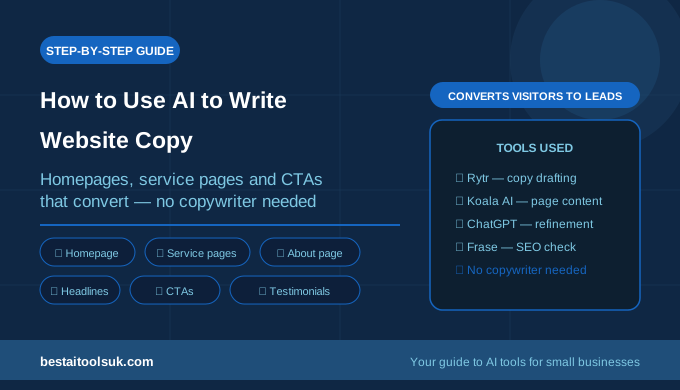
AI tools have genuinely transformed what is achievable for small business owners who want professional-quality website copy without the cost of a copywriter. The combination of Rytr for drafting specific copy sections — headlines, service descriptions, about pages, CTAs — and Koala AI or ChatGPT for producing longer-form page content covers the full website copywriting workflow at a combined cost of under twenty pounds per month.
The businesses that get the best results from AI-assisted website copywriting are those that invest time in the inputs — clarifying who their customer is, what problem they solve, and what makes them different — before asking the AI to write anything. The AI handles the drafting; the business owner provides the strategic thinking that makes the copy specific, credible, and genuinely persuasive. Try Rytr free here for website headlines, service descriptions, and CTAs — the free plan is sufficient to produce a complete website copy draft before committing to any subscription.
⭐ Try Rytr free — write professional website copy in minutes: Try Rytr free here⭐ Try Koala AI free — produce SEO-optimised website content faster: Try Koala AI free here
Published on bestaitoolsuk.com — Your trusted guide to AI tools for small businesses