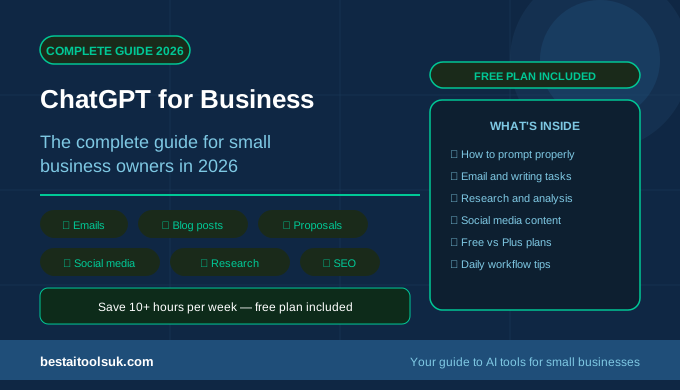
ChatGPT for Business: The Complete Guide for Small Businesses in 2026
Everything a small business owner needs to know about using ChatGPT effectively — from your first prompt to building AI into your daily workflow
This article contains affiliate links. If you purchase through these links, we may earn a commission at no extra cost to you. This does not affect our assessment — we only recommend tools we genuinely believe deliver value.
ChatGPT for business has gone from a curiosity to a competitive necessity in under two years. The small businesses that are growing fastest in 2026 are not necessarily the ones with the biggest budgets or the most staff — they are the ones that have figured out how to use AI tools to do more with less. And ChatGPT, used well, is the single most versatile tool available to any small business owner who wants to save time, produce better work, and operate more efficiently without hiring additional headcount.
The honest challenge is that most small business owners who try ChatGPT do not get anywhere near the value it is capable of delivering. They use it to answer a few questions, find the answers mediocre, and conclude that the tool is overhyped. The difference between mediocre ChatGPT results and genuinely useful ones comes down almost entirely to how you prompt it — the quality of what you put in determines the quality of what you get out. This guide covers everything you need to use ChatGPT effectively in your business, from basic setup through to the specific use cases that deliver the highest return on the time invested. For the full landscape of AI tools available beyond ChatGPT, see our guide to the best AI productivity tools for small businesses.
What Is ChatGPT and Which Version Should You Use?
ChatGPT is an AI assistant developed by OpenAI that uses large language models to understand and generate text. It can answer questions, write content, analyse information, generate ideas, write and explain code, and assist with an enormous range of tasks through a conversational interface. You interact with it the same way you would message a person — describing what you need, and refining the output through follow-up instructions.
There are two main versions available. The free plan uses GPT-3.5 Turbo — a capable model for everyday tasks including email drafting, basic research, and simple content generation. ChatGPT Plus at approximately sixteen pounds per month uses GPT-4o — OpenAI’s most capable model — which produces significantly better output on complex tasks, long-form writing, nuanced analysis, and anything requiring sophisticated reasoning. For most small business owners starting out, the free plan is sufficient to evaluate whether ChatGPT is useful for your specific workflow. For serious business use, ChatGPT Plus is worth the investment. See our comparison of ChatGPT vs Google Gemini and ChatGPT vs Microsoft Copilot for how it compares to the main alternatives.
What ChatGPT Can Do for Your Business: The Key Use Cases
| Business Task | How ChatGPT Helps | Time Saved |
| Email drafting | Writes first draft from brief description | 20–30 mins/email |
| Blog post research | Summarises topics, suggests angles | 1–2 hours/post |
| Social media captions | Generates multiple options per post | 15–20 mins/post |
| Customer service replies | Drafts responses to common queries | 10–15 mins/reply |
| Business proposals | Structures and drafts full proposals | 2–4 hours/proposal |
| Meeting prep | Creates agendas from brief description | 20–30 mins/meeting |
| Market research | Summarises industry trends and data | 1–3 hours/project |
| Job adverts | Drafts complete job descriptions | 30–45 mins/advert |
How to Get Better Results From ChatGPT: The Basics of Prompting
The most important skill in using ChatGPT for business is writing good prompts. A prompt is the instruction you give ChatGPT — and the quality of your prompt determines the quality of the output more than any other factor. Most people who get poor results from ChatGPT are using prompts that are too vague, too short, or missing the context that ChatGPT needs to produce useful output.
Give ChatGPT a Role
The simplest way to improve your ChatGPT outputs immediately is to tell it what role to adopt before giving your actual request. ‘You are an experienced marketing copywriter for small businesses. Write me a promotional email for my new service’ will produce significantly better output than ‘Write a promotional email for my new service.’ The role instruction tells ChatGPT what expertise to draw on, what audience to write for, and what standards to apply.
Provide Specific Context
ChatGPT produces better outputs the more specific context you provide. Compare ‘Write me a blog post about social media’ with ‘Write me a 1,200-word blog post about how small business owners can use Instagram to attract local customers. The audience is UK small business owners with no social media marketing experience. The tone should be practical and jargon-free.’ The second prompt produces dramatically better output because ChatGPT knows the format, the audience, the scope, and the tone. For the specific prompts that work best for different business writing tasks, see our guide to the best AI writing tools for small businesses which covers the prompting approaches that produce the strongest results across different content types.
Use Follow-Up Instructions to Refine
ChatGPT is a conversation, not a single-shot tool. If the first output is not quite right, tell ChatGPT specifically what to change — ‘Make it shorter’, ‘Use a more formal tone’, ‘Add more specific examples’, ‘Rewrite the opening paragraph to be more engaging’. Each follow-up instruction refines the output toward what you actually need. The business owners who get the most value from ChatGPT treat it as a collaborative editor rather than a vending machine.
Ask ChatGPT to Think Step by Step
For complex tasks — business analysis, strategic planning, problem-solving — adding ‘think step by step’ or ‘walk me through your reasoning’ to your prompt produces significantly more thorough and accurate outputs. This technique, called chain-of-thought prompting, encourages ChatGPT to work through problems systematically rather than jumping to conclusions.
ChatGPT for Business Writing
Writing and Responding to Emails
Email is one of the highest-value ChatGPT use cases for most small business owners — the combination of high volume and high time cost makes it an obvious candidate for AI assistance. For each email you need to write, provide ChatGPT with the context: who you are writing to, what the email needs to achieve, the key points to include, and the desired tone. ChatGPT will produce a complete first draft that requires editing rather than writing from scratch. For difficult emails — complaints, rejections, sensitive client communications — ChatGPT is particularly useful for finding language that is clear and professional without being harsh. See our guide on how to use AI to write cold emails that convert for the specific prompting approach that works best for sales and outreach emails.
Writing Blog Posts and Website Content
ChatGPT can significantly accelerate blog post and website content production — but for content that needs to rank on Google, you need more than ChatGPT alone. ChatGPT does not analyse what is currently ranking for your target keywords, which means it cannot tell you what your content needs to cover to be competitive in search. For SEO content production, the strongest workflow combines Frase for keyword research and content brief creation with ChatGPT or a specialist writing tool for the actual drafting. See our guide on how to do SEO without an agency for the complete workflow that combines AI tools to produce content that ranks.
Writing Proposals and Business Documents
Business proposals, quotes, terms of service, and other formal business documents are excellent use cases for ChatGPT. Provide the key details — the client’s requirements, your proposed solution, your pricing, and your timeline — and ChatGPT will structure these into a professional document format. The output will need personalisation and legal review for formal documents, but it eliminates the blank page problem and the structural thinking that consumes most of the time in proposal writing. For the specific proposal writing workflow, see our guide on how to use AI to write proposals.
ChatGPT for Research and Analysis
Market Research and Competitive Analysis
ChatGPT is a powerful research accelerator — it can summarise industry trends, explain market dynamics, describe competitor positioning, and identify questions you should be asking about a market. The important caveat is that ChatGPT’s training data has a knowledge cutoff and it does not have access to real-time information by default — so for current market data, use the web browsing capability on ChatGPT Plus or verify any specific statistics against current sources. For market analysis integrated with keyword research, see our guide to the best AI SEO tools for small businesses for the tools that surface current market data most effectively.
Summarising Long Documents
One of ChatGPT’s most practically useful capabilities for business owners is summarising long documents. Paste in a lengthy contract, research report, industry article, or set of meeting notes and ask ChatGPT to summarise the key points, extract the action items, or identify the most important clauses. This capability saves hours of reading time and is particularly valuable for business owners who need to stay across a lot of information without the time to read everything in full.
Financial and Strategic Analysis
ChatGPT can help small business owners think through strategic decisions by acting as a thinking partner. Describe your business situation, the decision you are facing, and the options you are considering — and ask ChatGPT to analyse the options, identify risks and opportunities you may have missed, and help you think through the implications. The output is not a substitute for professional financial or legal advice, but it is a useful first-pass analysis that helps you arrive at professional conversations better prepared.
ChatGPT for Customer Communications
Responding to Customer Enquiries
For businesses that receive repeated similar enquiries — about pricing, availability, process, or products — ChatGPT can dramatically reduce the time spent on customer communications. Create a template prompt that describes your business and the common enquiry types, and use it to generate polished responses to routine questions in seconds rather than minutes. For businesses managing customer service across multiple channels, see our guide to the best AI customer service tools for small businesses for the dedicated customer service tools that automate this process more systematically.
Writing FAQs and Help Content
ChatGPT is excellent for producing FAQ content and customer help documentation. List your most common customer questions, provide the answers in rough notes, and ask ChatGPT to convert these into polished, clear FAQ content suitable for your website. The resulting content is typically clearer and better structured than most business owners would produce themselves, because ChatGPT is skilled at explaining things from the customer’s perspective rather than the business owner’s.
ChatGPT for Social Media and Marketing
Generating Social Media Content
Social media caption and post generation is one of the most time-efficient ChatGPT use cases — provide a brief description of the post topic, your brand tone, and the platform, and ChatGPT generates multiple caption options in seconds. For businesses that post across multiple platforms, ask ChatGPT to adapt the same content for Instagram, LinkedIn, Facebook, and Twitter simultaneously. See our guide on how to use AI to write social media posts for the specific prompting workflow that produces the best results across different social platforms.
Marketing Copy and Advertising
ChatGPT produces solid first drafts of marketing copy — landing page headlines, Google Ads copy, promotional email subject lines, and advertising descriptions. The output quality for short, punchy copy is generally strong. For longer-form marketing content where brand voice consistency matters most, specialist tools like Rytr — which has purpose-built marketing copy templates — often produce stronger results with less editing. See our guide to the best AI writing tools for small businesses for the specialist writing tools that complement ChatGPT for high-volume marketing content production.
ChatGPT Limitations Small Business Owners Should Know
It Can Produce Plausible-Sounding Inaccuracies
ChatGPT occasionally generates information that sounds authoritative but is factually wrong — including fabricated statistics, incorrect dates, or inaccurate descriptions of laws and regulations. For any content that will be published or used in formal business contexts, verify specific facts, statistics, and legal information against authoritative sources. Never use ChatGPT-generated financial projections, legal clauses, or medical information without professional verification.
It Does Not Know Your Business
ChatGPT produces generic outputs unless you provide specific context about your business. The more you tell it — your industry, your customers, your tone of voice, your specific situation — the more useful the output. Building a set of standard context prompts that describe your business, your audience, and your typical use cases saves significant time and dramatically improves the consistency of outputs. For AI tools that learn your specific brand voice over time, see our guide on is Jasper AI worth it for the premium AI writing tool built around brand voice consistency.
The Free Plan Has Limitations
ChatGPT’s free plan uses GPT-3.5, which produces noticeably lower quality outputs on complex tasks than GPT-4o on the Plus plan. For casual use and simple tasks, the free plan is sufficient. For regular business use where output quality affects client perception or commercial outcomes, ChatGPT Plus at sixteen pounds per month is worth the investment. See our ChatGPT vs Google Gemini comparison for an assessment of whether Google’s free Gemini plan — which includes web browsing — might be a better free alternative for your specific use cases.
Building ChatGPT Into Your Daily Workflow
The small business owners who get the most value from ChatGPT are those who integrate it into their daily workflow as a default first step rather than an occasional resource. Before writing any email, draft a prompt. Before starting any research task, ask ChatGPT to brief you on the topic. Before any client meeting, ask ChatGPT to help you prepare. This habitual use builds the prompting fluency that transforms ChatGPT from an occasionally useful tool into a genuine productivity multiplier.
A practical approach to building this habit is to identify the three tasks in your week that consume the most time and try replacing each one with a ChatGPT-assisted workflow for two weeks. The time saving will be immediately visible, and the habit of reaching for AI assistance first will develop naturally. For the broader AI toolkit that extends well beyond ChatGPT for specific business tasks — writing, SEO, email marketing, customer service, accounting — see our guide to the best AI tools for small business marketing for the complete picture of what is available.
The Honest Verdict
ChatGPT is the most versatile and accessible AI tool available to small business owners in 2026, and the free plan provides enough capability to meaningfully improve the efficiency of most everyday business tasks. The business owners who get the best results are those who invest time in learning to prompt well — providing specific context, giving ChatGPT a role to adopt, and using follow-up instructions to refine outputs toward what they actually need.
For most small business owners, the right approach is to start with ChatGPT’s free plan and use it consistently for two to four weeks before deciding whether ChatGPT Plus is worth the sixteen pounds per month. For specialist tasks that go beyond what a general AI assistant handles well — SEO content that needs to rank, purpose-built business writing templates, email marketing automation — see our guides on the best AI SEO tools for small businesses, the best AI writing tools for small businesses, and the best AI email marketing tools for small businesses for the specialist tools that complement ChatGPT across each area of your business.
⭐ Want to go further than ChatGPT for business writing? Try Rytr free — purpose-built for business content: Try Rytr free here⭐ Try Frase — the AI SEO tool that helps your business rank on Google: Try Frase here
Published on bestaitoolsuk.com — Your trusted guide to AI tools for small businesses