ChatGPT vs Frase: Which Is Better for Small Business Content in 2026?
An honest comparison for small business owners trying to decide whether ChatGPT or Frase is the better investment for content that actually ranks on Google
This article contains affiliate links. If you purchase through these links, we may earn a commission at no extra cost to you. This does not affect our assessment — we only recommend tools we genuinely believe deliver value.
ChatGPT vs Frase is a comparison that comes up constantly among small business owners trying to build an SEO content strategy, and it is one where the obvious answer — ‘use the free one’ — turns out to be wrong in almost every case where ranking on Google is the actual goal. ChatGPT can write a blog post. Frase can tell you exactly what that blog post needs to cover to rank on Google, score it in real time as you write, and show you precisely where it falls short against the competition. Those are fundamentally different capabilities.
The honest truth is that ChatGPT without SEO guidance produces content that frequently disappears into search obscurity regardless of how well it is written. Frase without a writing tool still requires you to write the content yourself. The question is not which tool is better in isolation — it is which one solves the specific problem that is costing your small business the most traffic and opportunity right now.
This comparison answers that question directly. For individual tool reviews see our full Frase review and our guide on how to use Frase SEO to rank on Google.
ChatGPT vs Frase: The Core Difference
ChatGPT is a content generation tool. Frase is a content intelligence tool. Both produce written content, but the problems they solve are completely different.
ChatGPT answers the question ‘how do I write this article?’ Frase answers the question ‘what does this article need to contain to rank on Google?’ The first question is about execution. The second is about strategy. For small businesses trying to grow through organic search, the second question is the one that actually determines whether your content succeeds.
Most small business content fails to rank not because it is badly written but because it was written without understanding what Google expects a comprehensive article on that topic to cover. ChatGPT makes the writing faster. Frase makes the content strategically sound. You need both — which is exactly why the best workflow combines them rather than choosing one.
ChatGPT vs Frase: Full Comparison
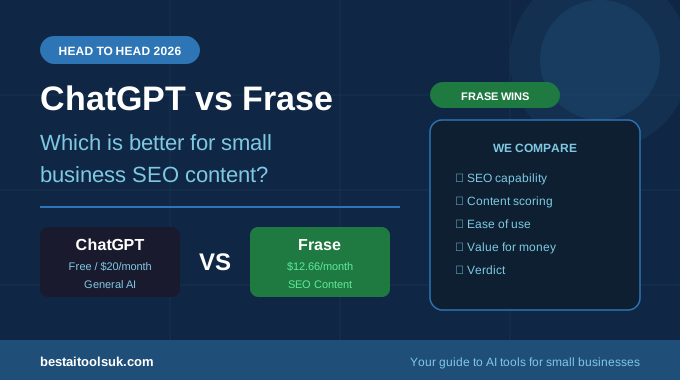
| Feature | ChatGPT | Frase |
| Price | Free / $20 per month | $12.66 per month |
| SERP analysis | None | Industry leading |
| Content scoring | None | Real-time as you write |
| Keyword research | Basic — needs prompting | Built in and automated |
| Topic research | Manual prompting required | Automated from top results |
| SEO blog writing | Possible but unguided | Specifically built for this |
| Real-time web data | ChatGPT Plus only | SERP data is always current |
| Content optimisation | None | Full competitor analysis |
| Learning curve | Steep for SEO tasks | Moderate — intuitive once learned |
| Best for | General AI tasks | SEO content that ranks |
Where ChatGPT Falls Short for SEO Content
No Understanding of What Google Wants
This is the fundamental limitation of using ChatGPT alone for SEO content. When you ask ChatGPT to write a blog post about a topic, it produces a well-written article based on its training data. It has no idea what is currently ranking for your target keyword, what topics the top results cover, how long the competing articles are, or what questions readers are asking that you need to answer. It writes in a vacuum.
The result is content that might be excellent in isolation but is uncompetitive in search because it was not built to the standard that Google currently expects for that keyword. Publishing ChatGPT content without SEO guidance is like entering a competition without knowing the judging criteria — you might get lucky occasionally but you are not playing to win.
Prompt Engineering Is Required for Quality SEO Output
Getting genuinely useful SEO guidance from ChatGPT requires sophisticated prompting. You need to ask it to analyse search intent, identify key topics, structure content for featured snippets, include semantic keywords, and target specific word counts — and even then, ChatGPT is generating all of this from its training data rather than from current search results. The information may be outdated, inaccurate, or simply not reflective of what is actually ranking right now.
For small business owners without an SEO background, this creates a significant problem. The people who get the best SEO results from ChatGPT are usually the ones who already understand SEO well enough that they could have done the research themselves. Frase solves this by doing the research automatically from live search data.
Where Frase Wins for SEO Content
Real SERP Data — The Feature That Changes Everything
When you enter a keyword in Frase, it analyses the top 20 results currently ranking on Google and tells you exactly what they cover — the topics, the questions they answer, the average word count, and a content score showing how comprehensively each article addresses the subject. This is live data from the actual search results, not training data from months ago.
The practical impact is transformative. Instead of guessing what a competitive article on your topic needs to cover, you know — with data — exactly what the standard is before you start writing. The content you produce is built to compete with what is actually ranking rather than what ChatGPT thinks should be ranking based on its training. Users on G2 who switched from ChatGPT-only workflows to Frase-guided content consistently report significantly higher first-page rankings within weeks of making the change.
Content Scoring in Real Time
As you write in Frase’s editor — or as you paste content in from another tool — the content score updates in real time showing you how your article compares to the top ranking results for your keyword. You can see at every moment exactly which topics you are still missing and how close you are to a competitive score. This feedback loop changes how you write in a way that ChatGPT simply cannot replicate.
The target is to match or exceed the average content score of the top three ranking articles. Frase shows you that benchmark clearly and tells you precisely what to add to reach it. This turns content creation from a guessing game into something much closer to a repeatable formula — which is what busy small business owners need. See our step by step guide on how to use Frase SEO to rank on Google for the complete workflow.
Optimising Existing Content
One of the most valuable and underused features in Frase is the ability to paste your existing content and run it through the content scoring system. If you have blog posts sitting on page two or three of Google, Frase often reveals exactly what they are missing — and adding two or three topic sections to an article that already has some Google authority is frequently enough to push it to page one. ChatGPT has no equivalent capability for auditing and improving existing content against current search standards.
The Honest Case for Using ChatGPT With Frase
The strongest content workflow for small businesses in 2026 is not ChatGPT or Frase — it is ChatGPT and Frase used together. Frase for the research and strategy phase: enter your keyword, analyse the SERP data, understand what your content needs to cover, and build your content brief. ChatGPT for the drafting phase: paste your Frase brief into ChatGPT and generate a first draft that covers all the required topics. Return to Frase for the optimisation phase: paste the ChatGPT draft back into Frase, check the content score, and add anything still missing.
This combined workflow gives you the strategic intelligence of Frase and the writing speed of ChatGPT. The cost is $12.66 per month for Frase alongside the free tier of ChatGPT — approximately £10 per month total. That is one of the most cost-effective SEO content setups available for a small business in 2026.
Who Should Use ChatGPT for Content
- Businesses that need AI capability across many different tasks beyond SEO content
- Anyone willing to invest time learning advanced SEO prompting techniques
- Businesses on the absolute tightest budget where even $12.66 per month is a constraint
- Content creators who already understand SEO well and can guide ChatGPT effectively
- Anyone producing content for purposes other than Google ranking — internal documents, emails, social posts
Who Should Use Frase for Content
- Small businesses whose primary growth channel is organic search traffic from Google
- Bloggers and content marketers who want their articles to actually rank rather than just exist
- Anyone currently publishing blog content that is not showing up in Google search results
- Businesses with existing content on page two or three that needs optimising to reach page one
- Anyone who wants a data-driven content strategy rather than publishing and hoping for the best
The Verdict: ChatGPT vs Frase for Small Business Content
For general AI tasks, ChatGPT wins — it is more versatile, more powerful across different use cases, and free at the basic tier. For SEO content specifically — blog posts intended to rank on Google and drive organic traffic to your small business — Frase wins because it solves the problem that ChatGPT ignores entirely: understanding what your content needs to contain to actually compete in search results.
The most honest recommendation is to use both. ChatGPT free for drafting and general tasks, Frase at $12.66 per month for SEO research, content scoring, and optimisation. That combination produces content that is both fast to create and strategically built to rank — which is the actual goal for any small business investing time in content marketing.
If you are currently using ChatGPT alone for your blog content and wondering why it is not driving Google traffic, Frase is almost certainly the missing piece. The difference between publishing content and publishing content that ranks is usually the difference between writing what you think is useful and writing what the data shows Google expects. Frase provides that data. ChatGPT does not. See our ChatGPT vs Rytr comparison for how ChatGPT stacks up against our top business writing tool.
⭐ If your blog content is not ranking on Google, Frase is very likely the missing piece. Try it and within your first session you will understand exactly why your content is not where it should be. Try Frase here → frase.io
Published on bestaitoolsuk.com — Your trusted guide to AI tools for small businesses