Rytr vs Writesonic: Which AI Writing Tool Is Worth It for Small Businesses in 2026?
An honest head-to-head comparison of two popular AI writing tools — so you can make the right choice for your business
This article contains affiliate links. If you purchase through these links, we may earn a commission at no extra cost to you. This does not affect our assessment — we only recommend tools we genuinely believe deliver value.
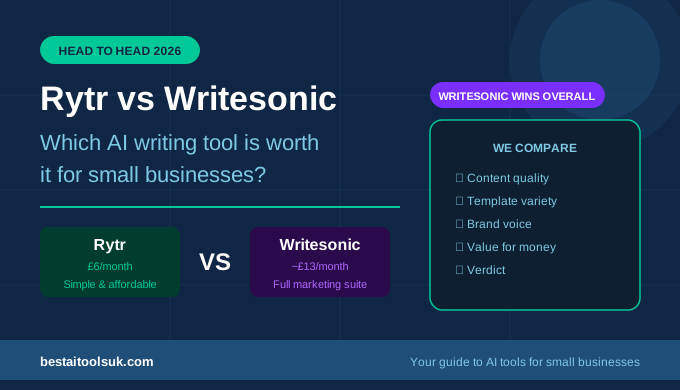
Rytr vs Writesonic is one of the most searched AI writing tool comparisons in 2026 — and for good reason. Both tools target small businesses and content creators, both promise to save hours of writing time every week, and both sit at very different price points. Rytr starts at six pounds a month. Writesonic starts at around thirteen pounds a month. That price gap matters, but it does not tell the whole story. What matters more is what each tool actually does well and whether that matches what your business needs.
The honest context is that Rytr and Writesonic serve overlapping but distinct audiences. Rytr is built for simplicity and accessibility — a broad template library at a low price for business owners who want to produce a wide variety of short-form content quickly. Writesonic is built for scale — a more powerful platform with advanced AI models, longer-form capabilities, and a wider feature set that justifies the higher price for businesses producing significant volumes of marketing content. This guide breaks down the real differences so you can make the right call.
Rytr vs Writesonic: Quick Comparison
| Feature | Rytr | Writesonic |
| Best for | Short-form content, variety | Long-form content, marketing teams |
| Starting price | £6/month | ~£13/month |
| Free plan | Yes — 10,000 characters/month | Yes — limited credits |
| Content templates | 40+ | 80+ |
| Long-form articles | Basic — section by section | Strong — full article generation |
| AI models | GPT-4 based | GPT-4 + Sonic models |
| Brand voice | Basic tone settings | Full brand voice training |
| G2 rating | 4.4/5 | 4.7/5 |
| Commission | 30% lifetime recurring | 30% first year |
What Is Rytr?
Rytr is an AI writing assistant built around speed and simplicity. With over forty use case templates covering cold emails, social media captions, product descriptions, blog outlines, business proposals, and more, Rytr helps small business owners produce a wide variety of content quickly without needing to learn a complex tool. You select a template, add a brief description of what you need, and Rytr generates publish-ready content in seconds.
Rytr’s free plan offers ten thousand characters per month — enough for several emails or social posts per week — making it the most accessible entry point of any AI writing tool at this price point. Reviewers on G2 consistently highlight that the free plan alone is enough to handle a solo trader’s weekly writing tasks, with the Saver plan at six pounds per month covering higher volumes comfortably. The Unlimited plan at approximately twenty-two pounds per month removes character limits entirely for high-output users.
The simplicity is Rytr’s biggest advantage. There is almost no learning curve — most users are generating usable content within five minutes of signing up. For a small business owner who needs to write a client follow-up email, a LinkedIn post, and a product description in the same afternoon, Rytr handles all three without friction. See our full Rytr review for the complete breakdown of features and best use cases.
What Is Writesonic?
Writesonic is a more comprehensive AI writing platform built for businesses that need to produce marketing content at scale. Where Rytr focuses on a clean, template-driven experience for short-form content, Writesonic covers a broader range of content types — long-form blog articles, landing pages, product descriptions, Google and Facebook ad copy, email sequences, and social media campaigns — within a single platform that also includes brand voice training and an AI chatbot called Chatsonic.
Writesonic’s pricing starts at approximately thirteen pounds per month, which reflects the broader feature set. The free plan offers limited credits — enough to test the tool but not to use it regularly. The standout feature that justifies the higher price for many users is Writesonic’s Sonic Editor, which generates complete long-form articles including research, headings, and body content — something Rytr’s section-by-section approach cannot match for speed or depth. G2 reviewers with four point seven out of five note that marketing teams particularly benefit from the ability to maintain consistent brand voice across multiple content formats from one platform.
Writesonic is best suited to businesses where content marketing is a significant activity — businesses running blogs, email newsletters, social media campaigns, and paid advertising simultaneously. For those users, the additional cost relative to Rytr is justified by the time saved across multiple channels. See our full Writesonic review for a complete assessment of who it works best for.
Rytr vs Writesonic: Head-to-Head Comparison
Content Quality
Rytr produces clean, usable content for short-form tasks that requires minimal editing before use. For emails, social posts, and product descriptions, the output is consistently solid and captures the intended tone accurately from a brief description. For long-form blog content, Rytr’s output requires more work — it generates sections rather than complete articles and the overall structure needs manual assembly.
Writesonic produces stronger long-form content. The Sonic Editor generates complete articles with a logical structure, relevant headings, and sufficient depth to be a genuine starting point for publishable blog posts. Quality reviewers on G2 note that Writesonic’s article output requires around thirty percent less editing time than comparable tools to reach a publishable standard. For short-form content, Writesonic is equally capable to Rytr — the difference in quality at this level is marginal.
Verdict: Writesonic wins for long-form content quality. Rytr is competitive for short-form.
Template Variety
Rytr offers over forty templates covering the most common small business writing tasks — emails, proposals, social posts, product descriptions, ad copy, and blog outlines. The template library is well curated rather than exhaustive, which keeps the interface clean and the tool easy to navigate.
Writesonic offers over eighty templates covering a broader range of content types including landing pages, press releases, email sequences, YouTube descriptions, and startup pitch decks alongside the standard library. For businesses with diverse content needs across multiple channels, the wider template library is a genuine advantage over Rytr’s more focused selection.
Verdict: Writesonic wins on template variety. Rytr’s selection covers most small business needs without feeling overwhelming.
Brand Voice and Consistency
Rytr offers basic tone settings — professional, casual, formal, persuasive — but does not offer brand voice training. Each generation starts fresh without memory of your brand’s specific language, style, or terminology. For solo business owners producing occasional content, this is not a significant limitation.
Writesonic offers full brand voice training. You can upload examples of your existing content, define your tone and style preferences, and Writesonic applies those settings consistently across all content it generates. For businesses where brand consistency matters — particularly those with multiple team members producing content — this feature alone justifies the price difference over Rytr.
Verdict: Writesonic wins on brand voice. Not relevant for solo users but significant for teams.
Ease of Use
Rytr is one of the simplest AI writing tools available. The interface is clean, the templates are clearly labelled, and new users are generating content within minutes of signing up. There is no setup process and no configuration required to start producing useful output.
Writesonic has a steeper learning curve due to its broader feature set. The Sonic Editor, brand voice settings, and multiple content generation modes take time to learn properly. Most users need an hour or two of exploration before the full capabilities click into place. Writesonic provides solid documentation and tutorials, but the additional complexity compared to Rytr is real.
Verdict: Rytr wins on ease of use. Writesonic rewards the investment in learning it.
Pricing and Value
Rytr’s free plan is genuinely useful — ten thousand characters per month covers real business writing tasks without requiring a paid subscription. The six pounds per month Saver plan is one of the most affordable paid AI writing tools available and delivers strong value for short-form content users. The Unlimited plan at twenty-two pounds per month is fair for high-volume users.
Writesonic’s free plan is limited to trial credits that run out quickly. The entry plan at approximately thirteen pounds per month is fair for the feature set but represents a meaningful commitment relative to Rytr. For businesses that genuinely use the long-form content, brand voice, and multi-channel capabilities, the value is strong. For businesses that primarily need short-form content, the additional cost over Rytr is harder to justify.
Verdict: Rytr wins on value for short-form and budget-conscious users. Writesonic wins for businesses with serious content marketing operations.
Customer Satisfaction
Rytr holds a 4.4 out of 5 rating on G2 across over eight hundred reviews. Users consistently praise the template variety, speed, and value of the Saver plan. The most common criticism is that long-form blog content requires significant editing to reach a publishable standard.
Writesonic holds a 4.7 out of 5 rating on G2 — one of the stronger ratings in the AI writing tool category. Reviewers particularly highlight the Sonic Editor’s long-form article quality and the brand voice consistency features. The most common criticism is the limited free plan and the learning curve for new users.
Verdict: Writesonic leads on G2 ratings, with notably strong scores for long-form content quality.
Who Should Choose Rytr?
Rytr is the right choice for small business owners, solo traders, and freelancers who need to produce a wide variety of short-form content quickly without a significant budget commitment. If your weekly writing tasks include client emails, social media posts, product descriptions, and the occasional proposal, Rytr handles all of these reliably for six pounds per month or less.
It is particularly well suited to businesses where content is a supporting activity rather than a primary growth channel — service businesses, local trades, consultants, and anyone who needs to write professionally but does not depend on content marketing for leads. The free plan makes it completely risk-free to test whether Rytr fits your workflow. Try Rytr free here — no credit card required.
Who Should Choose Writesonic?
Writesonic is the right choice for businesses where content marketing is a meaningful part of the growth strategy. If you publish blog posts regularly, run email campaigns, manage social media across multiple channels, and need consistent brand voice throughout, Writesonic’s broader capabilities justify the higher price point.
It is particularly strong for marketing teams, growing ecommerce businesses, and content agencies that need to produce high volumes of varied content without sacrificing quality or brand consistency. If you have found yourself using multiple specialist tools — one for blogs, one for social, one for emails — Writesonic consolidates most of those needs into a single platform at a price that compares favourably to paying for several tools separately. Start your Writesonic free trial here and test the Sonic Editor with your first long-form article.
Can You Use Rytr and Writesonic Together?
There is limited logic in using both tools simultaneously given the price overlap. The more practical combination for most small businesses is to start with Rytr — test whether AI writing genuinely saves you time and which tasks benefit most — and then upgrade to Writesonic if and when your content volume grows to a point where the additional capabilities are clearly valuable. Rytr is the better starting point; Writesonic is the natural upgrade for businesses that outgrow it.
The Honest Verdict
Rytr wins for accessibility, simplicity, and value for short-form content. Writesonic wins for long-form content quality, template variety, brand voice consistency, and overall capability for businesses with serious content marketing operations.
If you are a small business owner who needs to write faster without spending much money, start with Rytr. If you are running a content-driven business and producing blog posts, email campaigns, and social media content regularly, Writesonic’s stronger feature set and higher G2 satisfaction scores reflect a tool that genuinely delivers more for businesses that need more. The price difference between the two is real but so is the capability difference — choose based on what your business actually produces, not just what you think you might need.
⭐ Try Rytr free — no credit card required: Try Rytr free here⭐ Try Writesonic free today: Start your Writesonic free trial here
Published on bestaitoolsuk.com — Your trusted guide to AI tools for small businesses