How to Write Cold Emails That Get Replies Using AI in 2026
The practical guide to using AI writing tools to produce cold emails that actually get responses — and the principles that make cold email work in the first place
This article contains affiliate links. If you purchase through these links, we may earn a commission at no extra cost to you. This does not affect our assessment — we only recommend tools we genuinely believe deliver value.
How to write cold emails that get replies using AI is one of the highest-value applications of AI writing tools for any business that relies on outbound sales or partnership development. The challenge with cold email is not writing ability — it is the combination of volume, personalisation, and the specific structural principles that separate emails that get responses from emails that get deleted or ignored. Learning how to write cold emails that get replies using AI starts with understanding what makes cold email work in the first place.
AI writing tools address all three of these challenges. They handle the volume problem by generating drafts quickly. They provide structure that follows the principles of effective cold email without requiring you to know those principles consciously. And they allow for personalisation at scale — generating emails that feel specifically written for each recipient without requiring hours of manual customisation.
The honest starting point is that AI-generated cold emails still need human editing and genuine personalisation to work. A fully automated cold email sequence with no human input will perform poorly regardless of which AI tool generates it — because recipients can detect generic outreach and delete it without reading. This guide shows you how to use AI to handle the structural and time-consuming elements of cold email while you provide the personalisation that actually drives responses. See our guide to saving 10 hours a week with AI tools.
What Makes Cold Emails Work — The Principles AI Must Follow
Before using any AI tool for cold email, understanding the principles that make cold email effective is essential. AI tools that do not follow these principles produce emails that sound professional but do not convert. The most important principles are:
Relevance above everything. The single biggest predictor of cold email response rate is how relevant the email is to the recipient’s current situation, priorities, or problems. Generic emails that could have been sent to anyone are ignored. Emails that demonstrate specific knowledge of the recipient’s situation earn responses. AI tools can help you write compelling copy, but the relevance has to come from your research and personalisation.
Short over long. Cold emails that are too long are rarely read in full. The optimal length for a cold email is between seventy-five and one hundred and fifty words — enough to make your point clearly, not so long that the recipient never gets to the call to action. AI tools frequently generate emails that are too long. Edit aggressively.
One clear ask. Cold emails with multiple requests, multiple questions, or unclear calls to action rarely generate responses because the recipient does not know what action to take. Every cold email should end with one specific, low-friction ask — a fifteen-minute call, a quick reply, a connection request — not three different options or an open-ended invitation.
About them first, you second. The most common cold email mistake is opening with information about you or your business before establishing any relevance to the recipient. Open with something specific to them — their recent news, their stated problem, their industry context — before introducing yourself or your offer.
How to Use Rytr for Cold Email Writing
Step 1 — Select the Email Use Case
Open Rytr at rytr.me and navigate to the Generate tab. Select the Email use case from the dropdown — for cold outreach specifically, the Cold Email or Business Pitch use cases produce the most appropriate structural output. The Cold Email use case is structured to follow the relevance-first, short, single-ask principles that make cold email effective.
Step 2 — Set Your Tone
For cold email, the tone selection is critical. Formal is rarely appropriate for cold outreach — it creates distance rather than the conversational warmth that encourages replies. Conversational produces the most natural-sounding cold email output. Convincing works well for emails where the primary goal is driving a specific action. Avoid Enthusiastic for cold outreach — it reads as salesy and undermines credibility.
Step 3 — Write a Specific Brief
The quality of your cold email brief determines the quality of the output. A specific brief produces a targeted, relevant email. A vague brief produces a generic one. Here is what a strong cold email brief includes:
- Who you are sending to — their role, company, and any specific context you know
- Why you are reaching out — the specific relevance to their situation
- What you are offering — one sentence, specific and concrete
- What you want them to do — the single ask
Example strong brief: ‘Cold email to the marketing director of a mid-size accountancy firm. They recently posted about struggling to produce consistent LinkedIn content. I offer AI writing tool consultancy that helps professional services firms produce content in half the time. Asking for a fifteen-minute call to discuss how I could help.’
That level of specificity produces an email that feels researched and relevant rather than generic and automated.
Step 4 — Generate and Edit
Generate two variations and select the stronger one. Then edit aggressively — the most important edits are:
- Shorten the email if it exceeds 150 words — remove any sentences that do not directly serve the goal
- Personalise the opening — replace any generic opener with the specific detail that makes this email relevant to this recipient
- Check the call to action — make sure it is one specific ask, not multiple options
- Remove any sentence that is about you rather than them in the first half of the email
The Most Effective Cold Email Structures
The Problem-Agitate-Solve Structure
Open with a specific reference to a problem the recipient likely has — ideally one they have mentioned publicly or that is common in their industry. Briefly acknowledge why that problem is frustrating or costly. Then introduce your solution as a specific response to that problem. This structure works because it demonstrates relevance before asking for anything.
The Compliment-Relevance-Ask Structure
Open with a genuine, specific compliment — something you actually found impressive about their work, company, or content. Connect that observation to why you are reaching out — what the relevance is between what you noticed and what you offer. Then make your ask. This structure builds rapport before asking for anything and signals that you have done genuine research.
The Mutual Connection Structure
When you have a genuine connection with the recipient — a shared contact, a shared event, a shared publication — lead with that connection before anything else. Shared context is the single most effective opener for cold email and produces significantly higher response rates than any other approach when it exists. AI tools can help you structure the rest of the email but the mutual connection detail must come from your actual knowledge.
Building a Cold Email Sequence With AI
A single cold email rarely generates a response even when it is excellent. Most outbound sales success comes from sequences — typically three to five emails sent over two to three weeks that maintain consistent relevance without becoming pushy or repetitive. AI tools are particularly valuable for sequence writing because producing five variations that maintain coherent narrative while avoiding repetition is time-consuming to do manually.
Use Rytr’s Follow-up Email use case for the second and subsequent emails in a sequence. Strong follow-up sequences do not simply remind the prospect that you exist — they add new information, new angles, or new value in each email. The first follow-up might share a relevant case study. The second might reference a piece of content they produced. The third might offer something free and immediately useful. AI tools help you maintain the professional tone and structural coherence across a sequence while you provide the specific content that makes each email worth reading.
See our full guide on how to use Rytr to write emails faster for the complete email writing workflow including follow-up sequences.
What to Expect From AI-Assisted Cold Email
Realistic cold email response rates — even with excellent copy — are between two and ten percent depending on the quality of your list, the relevance of your offer, and the strength of your personalisation. AI tools improve the quality and speed of cold email production but they do not change the fundamental economics of cold outreach. A well-written, highly personalised cold email still only gets a response from a small minority of recipients.
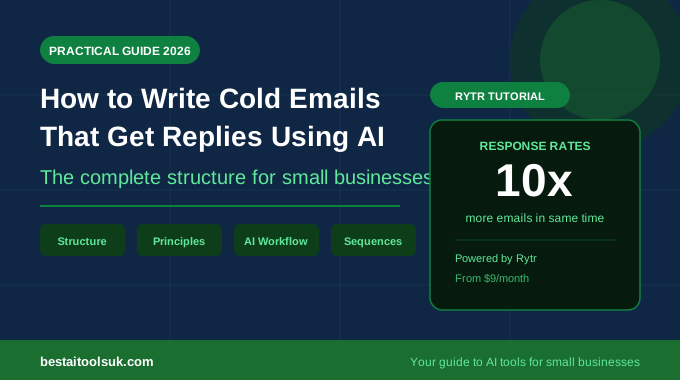
What AI tools do change is the efficiency of producing high-quality cold emails at volume. If a single well-crafted cold email sequence previously took three hours to write and now takes thirty minutes with AI assistance, you can run ten times as many sequences in the same time. At the same response rates, that means ten times as many replies, ten times as many conversations, and ten times as many potential clients or partners.
⭐ Start writing cold emails that get replies in a fraction of the time. Rytr’s Email and Cold Email use cases produce professional outreach copy in seconds. Try Rytr free here → rytr.me
Published on bestaitoolsuk.com — Your trusted guide to AI tools for small businesses