How to Use AI to Write Cold Emails That Convert in 2026
The practical guide to using AI writing tools to produce cold emails that get opened, read and replied to — without sounding like a robot
This article contains affiliate links. If you purchase through these links, we may earn a commission at no extra cost to you. This does not affect our assessment — we only recommend tools we genuinely believe deliver value.
How to use AI to write cold emails that convert is one of the most practically valuable skills a small business owner can develop in 2026. Cold email remains one of the highest-return outreach channels available — a well-written email sent to the right person still converts at rates that most paid advertising cannot match. The problem has never been the channel. The problem has always been the writing — specifically, the gap between the cold emails most business owners send and the cold emails that actually generate replies. AI writing tools close that gap significantly, producing professionally structured, compelling cold emails in seconds rather than the thirty minutes most people spend staring at a blank screen.
The honest context is that AI writing tools do not solve the fundamentals of cold email — targeting the right person, offering genuine value, and following up persistently. What they solve is the writing itself: the opening line, the value proposition, the call to action, and the overall structure that determines whether a recipient reads beyond the first sentence. Used correctly, AI tools produce cold emails that are consistently better than what most small business owners write manually, and produce them in a fraction of the time. See our guide on how to write cold emails that get replies using AI for the companion guide covering strategy alongside the writing process.
Why Most Cold Emails Fail
The majority of cold emails fail for one of three reasons: they open with something the recipient does not care about, they focus on the sender rather than the recipient’s problem, or they make a request that requires too much commitment too early. AI writing tools, used with the right prompts, address all three of these failures by producing emails that are built around the recipient’s perspective from the first word.
Understanding these failure modes is essential before using any AI tool for cold email, because an AI tool will produce exactly what you ask it to produce. If you ask it to write a cold email about your services, it will produce an email focused on your services — which is exactly the wrong approach. The prompts you give the AI tool are what determine whether the output converts or not. This guide covers both the tool and the prompt strategy. For the broader picture of how AI tools save time across different business writing tasks, see our guide on how to save time using AI writing tools.
The Best AI Tool for Writing Cold Emails
Rytr is the strongest AI writing tool for cold email production. The dedicated cold email and outreach email templates are built specifically for the structure that converts — a personalised opening line, a concise value proposition, social proof where relevant, and a low-friction call to action. The output is consistently professional, avoids the generic AI phrasing that recipients have learned to dismiss, and requires only light personalisation before sending. At six pounds per month for the Saver plan — with a free plan offering ten thousand characters per month — Rytr is accessible to any business owner who wants to test AI-assisted cold email before committing. See our full Rytr review for the complete breakdown of features beyond cold email.
For business owners who also want to reduce reliance on cold outreach by building inbound leads through content, Frase is the strongest complementary tool — producing SEO-optimised content that brings prospects to you rather than requiring you to reach out to them. See our full Frase review for how inbound and outbound strategies can work together.
How to Use Rytr to Write Cold Emails That Convert
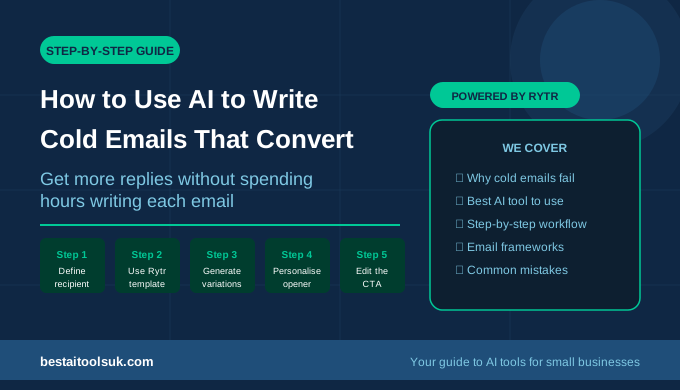
Step 1 — Define Your Recipient Before You Write
The single most important step in AI-assisted cold email production is defining exactly who you are writing to before you open the tool. The more specific your recipient definition, the better the AI output. Before starting Rytr, write down three things: the specific role or type of person you are emailing, the problem they are most likely experiencing that your offer addresses, and one concrete outcome you can help them achieve.
For example, rather than writing to ‘small business owners’, write to ‘marketing managers at ecommerce businesses with under fifty employees who are struggling to produce enough content to maintain their SEO rankings.’ That specificity feeds directly into the prompt and produces an email that feels written for the recipient rather than sent to a list.
Step 2 — Open Rytr and Select the Cold Email Template
In Rytr, select the ‘Cold Email’ or ‘Outreach Email’ use case from the template library. You will be asked to enter details about your product or service, your target audience, and the tone of the email. Enter the specific information from Step 1 rather than generic descriptions. The more context you provide, the more targeted and compelling the output will be. For a complete walkthrough of how to use Rytr across different email types, see our guide on how to use Rytr to write emails faster.
Step 3 — Generate Multiple Variations
Rytr generates multiple output variations for each prompt — always generate at least three. The first output is rarely the strongest. Read all three, identify the opening line and value proposition that feels most natural and compelling, and build your final email from the best elements across the variations. This takes two minutes and produces a meaningfully better email than accepting the first output.
Step 4 — Personalise the Opening Line
The opening line is where AI cold emails most commonly fail. Generic openers — ‘I hope this email finds you well’, ‘I came across your website’, ‘I wanted to reach out’ — are the fastest way to get your email deleted. Replace the AI-generated opener with one specific, genuine observation about the recipient or their business. This takes thirty seconds and is the single highest-impact edit you can make to any AI-generated cold email.
Effective personalised openers reference something specific — a recent company announcement, a piece of content they published, a challenge common to their specific industry, or a mutual connection. The body of the email can be AI-generated, but the opener should be genuinely personal.
Step 5 — Edit the Call to Action
The call to action in most AI-generated cold emails asks for too much — a thirty-minute call, a demo booking, or a meeting request. These are high-commitment requests from a cold contact who has no reason yet to give you their time. Replace the default AI call to action with a low-friction alternative: a single yes or no question, a request for the right person to speak to, or a specific piece of information that requires only a brief reply.
Low-friction calls to action consistently generate higher reply rates than meeting requests from cold contacts. The goal of the first email is a reply, not a meeting — the meeting comes later. For more on the strategy behind this approach, see our guide on how to write cold emails that get replies using AI for the full framework.
Cold Email Frameworks That Work With AI Tools
The Problem-Agitate-Solve Framework
This is the most reliable cold email structure for business-to-business outreach. The email opens by identifying a specific problem the recipient is likely experiencing, briefly agitates the consequences of leaving it unsolved, and then introduces your solution as the answer. Rytr’s cold email template is built around this structure — your prompt should focus on articulating the problem as specifically as possible.
The Social Proof Framework
This structure leads with a result you have achieved for a similar business — ‘We helped a recruitment agency in Manchester reduce their time spent writing job adverts by sixty percent’ — and then connects that outcome to the recipient’s situation. It works because it replaces your claim about what you can do with evidence of what you have already done. Rytr handles this framework well when you provide the social proof example in your prompt. For more on how to write compelling business content generally, see our guide on how to write a business proposal for the principles that transfer directly to cold email.
The Question Framework
This is the simplest and often most effective cold email structure for small businesses. The email asks one specific, relevant question that the recipient can answer in one or two sentences — ideally a question whose answer reveals whether they are a good prospect. It is short, non-threatening, and easy to reply to. Rytr produces strong question-framework emails when prompted specifically for this approach.
Common Mistakes When Using AI for Cold Email
The most common mistake is sending the AI output without editing. AI-generated cold emails are first drafts, not finished emails. The personalised opener, the specific call to action, and the genuine voice that builds trust all require human input. An unedited AI cold email reads like an unedited AI cold email — and recipients in 2026 are very good at identifying them.
The second most common mistake is using AI to send higher volumes of generic emails rather than better-targeted emails. AI tools should be used to improve quality and consistency, not to send more emails to less qualified recipients. A hundred well-targeted, personalised emails outperform a thousand generic ones by a significant margin.
The third mistake is ignoring the subject line. Rytr generates subject line options alongside the email body — always test two or three subject lines, as the subject line determines whether the email gets opened at all. A strong AI-generated email with a weak subject line will not convert. For tools that help with all aspects of business writing beyond cold email, see our guide to the best AI writing tools for small businesses.
The Honest Verdict
AI writing tools — specifically Rytr — genuinely improve cold email quality and reduce production time for small business owners. The output is consistently more professional and better structured than what most people write manually, and the time saving is real. The caveat is that AI produces the framework and the language, but the targeting, the personalisation, and the follow-up strategy still require human input and effort.
The business owners who get the best results from AI cold email tools are those who use AI to produce a strong, well-structured base email quickly, then invest the time saved into better personalisation and smarter targeting. That combination — AI efficiency plus human judgement — consistently outperforms both manual writing and pure AI output. Try Rytr free here and write your first AI-assisted cold email today — the free plan is enough to test the cold email template with a real outreach campaign.
⭐ Try Rytr free — write better cold emails in seconds: Try Rytr free here⭐ Try Frase — produce content that ranks and drives inbound leads: Try Frase here
Published on bestaitoolsuk.com — Your trusted guide to AI tools for small businesses