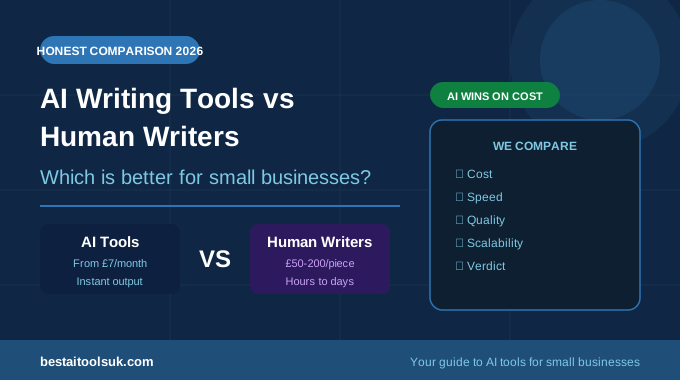
AI Writing Tools vs Human Writers: Which Is Better for Small Businesses?
The honest answer to one of the most common questions in small business content — and why the real answer is more nuanced than most people expect
This article contains affiliate links. If you purchase through these links, we may earn a commission at no extra cost to you. This does not affect our assessment — we only recommend tools we genuinely believe deliver value.
AI writing tools vs human writers is a question every small business owner is asking in 2026 — and the honest answer is that framing it as a competition misses the point entirely. The businesses getting the best content results are not choosing between AI and human writers. They are using AI tools to handle the high-volume, repeatable writing tasks while reserving human expertise for the work that genuinely requires it.
That said, the question deserves a direct answer for small businesses that cannot afford both and need to make a choice. AI writing tools win on cost and speed by a margin that is not close. Human writers win on genuine creativity, specialist expertise, and the kind of insight that comes from actually living and working in an industry. Which matters more depends entirely on what you are producing the content for.
This guide gives you the honest breakdown of both options across every factor that matters for small business content — cost, quality, speed, SEO, and long-term value — so you can make the right decision for your specific situation rather than following a general recommendation that may not apply to you.
AI Writing Tools vs Human Writers: The Key Comparison
| Factor | AI Writing Tools | Human Writers |
| Cost | £7 to £50/month | £50 to £200+ per piece |
| Speed | Minutes per piece | Hours to days per piece |
| Consistency | Consistent every time | Variable by writer and day |
| Brand voice | Trainable — Jasper does this well | Natural — writer learns over time |
| Creativity | Good — not exceptional | Excellent — genuine originality |
| Industry expertise | General knowledge only | Specialist knowledge available |
| SEO optimisation | Frase adds this layer | Depends on writer’s SEO knowledge |
| Scalability | Unlimited — no extra cost | Cost scales with volume |
| Editing required | Always — AI needs human polish | Minimal for experienced writers |
| Best for | High volume, consistent content | High-value, specialist content |
The Case for AI Writing Tools
Cost — The Gap Is Enormous
The cost difference between AI writing tools and professional human writers is one of the starkest comparisons in small business operations. A professional UK freelance copywriter charges between £50 and £200 per piece of content depending on length, complexity, and experience level. A blog post costs between £150 and £400. A series of social media posts costs £50 to £100 per week. An email newsletter costs £75 to £200 per send.
Rytr at approximately £7 per month produces unlimited email drafts, social captions, and proposal copy within its character limits. Koala AI at $9 per month generates complete long-form blog posts. Frase at $12.66 per month provides SEO intelligence that freelance writers typically charge extra for or do not provide at all. The combined cost of a comprehensive AI writing stack — Rytr plus Frase — is approximately £17 per month. That is less than the cost of a single professionally written blog post from a freelance copywriter.
For small businesses producing regular content across multiple formats, the economics of AI tools are simply impossible to argue against from a pure cost perspective. See our guide to the best AI writing tools for small businesses for the full breakdown of what each tool costs and delivers.
Speed and Scalability
A human writer producing a 1,500 word blog post typically takes between three and six hours from brief to final draft. Koala AI produces the same length article in about three minutes. Rytr generates a professional email draft in ten seconds. The speed advantage of AI tools is not marginal — it is transformational for businesses that need to produce content at volume.
More importantly, AI tools scale without additional cost. Producing twice as much content costs exactly the same as producing half as much. For a human writer, doubling output doubles cost. For a small business trying to build content momentum quickly — publishing multiple blog posts per week, maintaining daily social media presence, sending regular email newsletters — the scalability of AI tools removes the primary constraint that stops most small businesses marketing themselves as consistently as they should.
Consistency
Human writers have good days and bad days. A writer who produces brilliant work when well-rested and inspired produces noticeably different work when tired, rushed, or working on a topic that does not engage them. AI tools produce consistent output regardless of the equivalent of those variables. The quality ceiling of a human writer at their best is higher than AI — but the quality floor of AI is higher than a human writer at their worst.
For small businesses where brand voice and professional standards need to be maintained consistently across all content — not just on the days when writing feels inspired — AI tools provide a reliability that is genuinely valuable.
The Case for Human Writers
Genuine Creativity and Original Thinking
This is where human writers maintain a clear advantage that AI tools have not closed. A talented human writer brings genuine creative thinking — unexpected angles, original metaphors, counterintuitive observations, and the kind of insight that comes from actually experiencing the world rather than processing text about it. The best human writing has a quality that is recognisably human: surprising, specific, occasionally imperfect in ways that make it more rather than less compelling.
AI writing is competent, professional, and occasionally excellent. It is rarely genuinely surprising. For businesses where content is a genuine competitive advantage — where the writing itself is part of what makes the brand distinctive — human writers produce a ceiling of quality that AI tools currently cannot reach.
Specialist Industry Expertise
A human writer with deep expertise in your specific industry brings knowledge that cannot be replicated by an AI tool trained on general data. A former accountant writing financial content, a retired doctor writing healthcare content, or an ex-marketing director writing B2B content brings genuine insider knowledge — the kind that produces the specific, authoritative insights that readers recognise as expert rather than researched.
For industries where expertise and credibility are central to the content’s value — legal, financial, medical, technical — specialist human writers produce content that AI tools simply cannot match regardless of how well the prompts are constructed. Google’s E-E-A-T framework specifically rewards this kind of demonstrated expertise, and content that cannot show genuine experience and authority is increasingly disadvantaged in search.
Nuanced Understanding of Audience
An experienced human writer who knows your audience well develops an intuitive understanding of what resonates — the specific frustrations, aspirations, vocabulary, and cultural references that make content feel genuinely written for that reader rather than at them. This understanding deepens over time in a way that AI tools, which reset with each session, do not replicate.
For businesses with highly specific or niche audiences where content needs to demonstrate deep community understanding to earn trust, a human writer embedded in that community over time produces something qualitatively different from AI-generated content — and the audience notices.
The Honest Reality for Most Small Businesses
Most small businesses do not need to choose between AI tools and human writers — they need to choose which tasks each is best suited for. The businesses getting the best content results in 2026 are using AI tools for the high-volume repeatable work and human expertise for the high-value differentiated work.
In practice this means: AI tools for email writing, social media captions, blog post first drafts, product descriptions, and proposal frameworks. Human expertise — which might be your own knowledge as the business owner — for the specific insights, personal stories, industry observations, and genuine expertise that make the content worth reading in the first place.
The AI handles the scaffold. The human provides the substance. That combination is both more affordable than hiring a full-time writer and more effective than using AI alone for everything.
When to Use AI Writing Tools
- High volume content where speed and cost matter more than creative distinction — social media, email newsletters, standard blog posts
- Structured business writing where templates improve consistency — proposals, email sequences, job descriptions
- Content that follows predictable formats where AI performs reliably — product descriptions, FAQs, how-to guides
- First draft generation to speed up the writing process before human editing and personalisation
- Any content task where a £7 to £50 per month tool can deliver 80 percent of the value of a £150 per piece human writer
When to Use Human Writers
- Content where genuine expertise and credibility are central to the value — specialist technical, medical, financial, or legal content
- Brand-defining content where creative distinction is a competitive advantage — thought leadership, brand storytelling, campaign creative
- Content for audiences where deep community understanding is required to earn trust
- High-stakes content where getting it wrong has significant consequences — investor communications, crisis communications, regulatory content
- Any content task where the human insight, creativity, or expertise is genuinely irreplaceable rather than theoretically preferable
The Verdict: AI Writing Tools vs Human Writers
For most small businesses in 2026, AI writing tools are the right starting point — not because they are better than human writers in absolute terms, but because they deliver 80 percent of the value at five to ten percent of the cost. For a small business with limited marketing budget, that trade-off is almost always the right one. See our best free AI writing tools guide.
Start with AI tools. Use them to build content momentum, establish a publishing cadence, and demonstrate that content marketing delivers results for your business. Once you have proven that content drives traffic, leads, and sales, invest in human expertise for the specific content types where it genuinely makes a difference — and use AI to handle everything else at scale.
The businesses that struggle with this choice are usually the ones applying premium content thinking to commodity content tasks. A weekly social media caption does not need a human writer. A thought leadership piece that defines your brand’s position in the market does. Knowing the difference — and allocating your writing budget accordingly — is the most important content decision a small business owner makes.
⭐ Ready to start with AI writing tools? Rytr’s free plan gives you 10,000 characters per month with no time limit — enough to test whether AI saves you meaningful time before spending anything. Try Rytr free here → rytr.me For SEO blog content that ranks on Google, add Frase. Try Frase here → frase.io
Published on bestaitoolsuk.com — Your trusted guide to AI tools for small businesses