GetResponse vs Mailchimp: Which Is Better for Small Businesses in 2026?
A direct comparison of the two most popular email marketing platforms — so you can choose the right one without switching later
This article contains affiliate links. If you purchase through these links, we may earn a commission at no extra cost to you. This does not affect our assessment — we only recommend tools we genuinely believe deliver value.
GetResponse vs Mailchimp is the comparison that most small business owners face when they decide to get serious about email marketing. Both platforms are well-established, both offer free plans to start, and both are used by millions of businesses worldwide. But they suit different business situations, and choosing the wrong one now means a disruptive and time-consuming migration later when you outgrow it. This guide gives you a direct answer based on where each platform genuinely excels and where it falls short — so you can make the right choice from the start.
The short answer is that Mailchimp is the right starting point for complete beginners who need simplicity above all else, while GetResponse is the stronger choice for businesses that plan to grow their list, need more sophisticated automation, or want better value as their subscriber count increases. The longer answer depends on your specific situation — which this guide covers in detail. For the broader context of AI email marketing tools available to small businesses, see our guide to the best AI email marketing tools for small businesses.
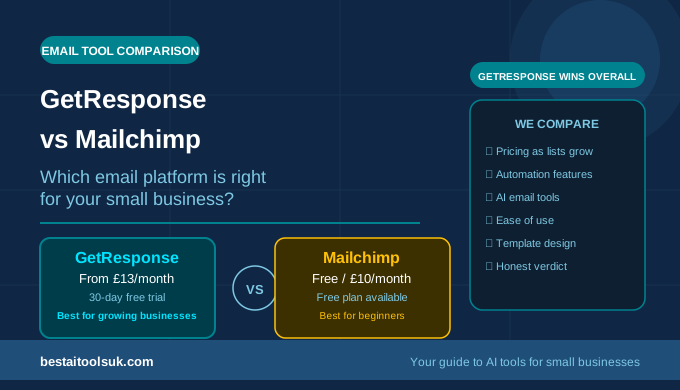
GetResponse vs Mailchimp: Quick Comparison
| Feature | GetResponse | Mailchimp |
| Starting price | £13/month | Free / £10/month |
| Free plan | Yes — 500 contacts | Yes — 500 contacts |
| Automation | ✓ Advanced workflows | Basic automations only |
| AI email generation | ✓ Full campaign builder | Content Optimizer |
| Landing pages | ✓ Built in | ✓ Built in |
| Webinars | ✓ Native feature | No |
| SMS marketing | ✓ Available | No |
| A/B testing | ✓ Comprehensive | Subject lines only (free) |
| Pricing model | Contact-based | Contact-based |
| Best for | Growing businesses | Beginners |
What Is GetResponse?
GetResponse is a comprehensive email marketing and automation platform that has been serving small and medium businesses since 1998. Beyond core email marketing, GetResponse includes marketing automation with visual workflow builders, landing page creation, webinar hosting, SMS marketing, and an AI email generator that produces complete campaigns from brief descriptions. The platform is designed to be an all-in-one marketing hub rather than a standalone email tool — which makes it more powerful than Mailchimp for businesses that need multiple marketing capabilities in a single platform. See our guide to the best AI email marketing tools for small businesses for how GetResponse compares to the full range of alternatives.
What Is Mailchimp?
Mailchimp is the most widely recognised email marketing platform in the world — the default choice for businesses that are new to email marketing and want the most accessible, beginner-friendly starting point. The platform has evolved significantly from its origins as a simple newsletter tool, adding automation features, landing pages, a website builder, and basic CRM functionality. For businesses with simple email marketing needs — a newsletter, a welcome sequence, and occasional promotional emails — Mailchimp covers the requirements with a clean, intuitive interface that requires minimal learning time.
GetResponse vs Mailchimp: Head-to-Head
Pricing
Both platforms offer free plans for up to five hundred contacts — which means the starting point is identical for businesses just beginning to build their list. The pricing diverges significantly as lists grow. Mailchimp’s pricing increases steeply as contact numbers rise — by the time you reach five thousand contacts, Mailchimp’s Essentials plan costs approximately £45 per month. GetResponse’s Email Marketing plan for five thousand contacts costs approximately £40 per month and includes more features, particularly around automation, than Mailchimp’s equivalent plan. For businesses that expect to grow their list to ten thousand contacts or beyond, GetResponse consistently offers better value per contact than Mailchimp at equivalent feature levels.
Verdict: Both free plans are equivalent for small lists. GetResponse offers better value as lists grow.
Automation
This is the most significant functional difference between the two platforms. GetResponse’s automation builder uses a visual drag-and-drop workflow interface that allows businesses to create sophisticated behavioural sequences — welcome sequences triggered by specific actions, abandoned cart recovery, lead scoring, and conditional logic that sends different emails based on subscriber behaviour. Mailchimp’s automation capabilities on the free and lower-paid plans are significantly more limited — basic welcome emails and simple time-based sequences are available, but the sophisticated behavioural workflows that drive the highest email marketing returns require higher-tier plans.
Verdict: GetResponse wins on automation. Mailchimp’s automation is limited on lower-tier plans.
AI Features
Both platforms have added AI features in recent years, but they approach them differently. GetResponse’s AI email generator produces complete email campaigns — subject lines, preview text, and body copy — from a brief description of the goal and audience. The AI subject line generator produces multiple variants and recommends the highest-performing option. Mailchimp’s AI features centre on the Content Optimizer, which analyses existing email copy and suggests improvements, and subject line recommendations based on engagement data. Both are genuinely useful additions that save time — GetResponse’s AI generation is more comprehensive, while Mailchimp’s Content Optimizer is better for improving existing copy. For producing the email copy that goes into either platform, see our guide on how to use AI for email marketing.
Verdict: GetResponse wins on AI generation. Mailchimp wins on copy improvement suggestions.
Ease of Use
Mailchimp wins on ease of use for complete beginners. The interface is cleaner, the onboarding process is more guided, and the learning curve is shallower than GetResponse. For a business owner who has never used an email marketing platform before and wants to send their first newsletter with minimal friction, Mailchimp gets you there faster. GetResponse is not difficult to use for people with some digital marketing familiarity, but the broader feature set and more sophisticated automation capabilities add interface complexity that beginners can find overwhelming initially.
Verdict: Mailchimp wins on ease of use for beginners. GetResponse is accessible but has more complexity.
Templates and Design
Both platforms offer extensive email template libraries covering promotional emails, newsletters, welcome messages, and event announcements. Mailchimp’s template designs are widely considered the more polished of the two — the aesthetic quality of the default templates is higher, and the drag-and-drop email builder is more intuitive for non-designers. GetResponse’s templates are functional and professional but less visually distinctive than Mailchimp’s best designs. For businesses where email design quality is a priority, Mailchimp has a slight edge.
Verdict: Mailchimp wins on template design quality. GetResponse templates are functional but less polished.
Additional Features
GetResponse includes several features that Mailchimp does not offer — native webinar hosting, SMS marketing, and a more comprehensive landing page builder with conversion optimisation features. For businesses that host webinars as part of their marketing strategy, GetResponse’s native webinar capability removes the need for a separate tool like Zoom or Webex. For businesses building their email list through landing pages, GetResponse’s landing page features are more comprehensive than Mailchimp’s. These additional features are not relevant for every business, but for those that use them they significantly improve GetResponse’s value proposition relative to the price.
Verdict: GetResponse wins on additional features — webinars, SMS, and landing pages are all stronger.
Who Should Choose GetResponse
GetResponse is the right choice for small businesses that plan to grow their email list beyond a thousand contacts, need sophisticated automation capabilities beyond basic welcome sequences, want to use webinars or SMS marketing alongside email, or want the best value as their list grows. It is also the right choice for businesses that are already on Mailchimp and finding that the pricing is increasing faster than the value they receive. GetResponse’s free trial allows you to test the full feature set before committing. Try GetResponse free here.
Who Should Choose Mailchimp
Mailchimp is the right choice for complete beginners who are sending their first email newsletter and want the most accessible, beginner-friendly experience available. It is the right choice for businesses with very simple email marketing needs — a regular newsletter and an occasional promotional email — where the sophistication of GetResponse’s automation is more than required. And it is the right choice for businesses that are deeply integrated with Mailchimp’s ecosystem — using its website builder, CRM, or third-party integrations — where the cost and disruption of switching outweigh the benefits of moving to GetResponse.
Can You Switch Between Platforms?
Yes — both platforms allow you to export your subscriber list and import it into a competitor. The practical cost of switching is primarily the time required to rebuild email templates, automation sequences, and integrations in the new platform. For businesses still in the early stages of their email marketing programme — with simple sequences and small lists — switching costs are low. For businesses with complex automation workflows and large lists, switching becomes significantly more disruptive. This is why choosing the right platform from the start matters. See our guide to the best AI email marketing tools for small businesses for the full range of alternatives if neither platform suits your specific situation.
The Honest Verdict
GetResponse is the stronger platform for most small businesses that are serious about email marketing as a growth channel. The automation capabilities are more sophisticated, the value improves as lists grow, and the additional features — webinars, SMS, landing pages — provide genuine utility for businesses that use them. Mailchimp is the right starting point for complete beginners who prioritise simplicity and are starting with a very small list.
The most common mistake small businesses make with email marketing platforms is starting with Mailchimp for its simplicity and then finding themselves paying significantly more than alternatives as their list grows — without getting proportionally more value. If you are serious about building an email list as a business asset, GetResponse is the stronger long-term choice. Try GetResponse free here and compare the automation and feature set against what you need before committing to either platform.
⭐ Try GetResponse free for 30 days — stronger automation and better value as your list grows: Try GetResponse free here
Published on bestaitoolsuk.com — Your trusted guide to AI tools for small businesses